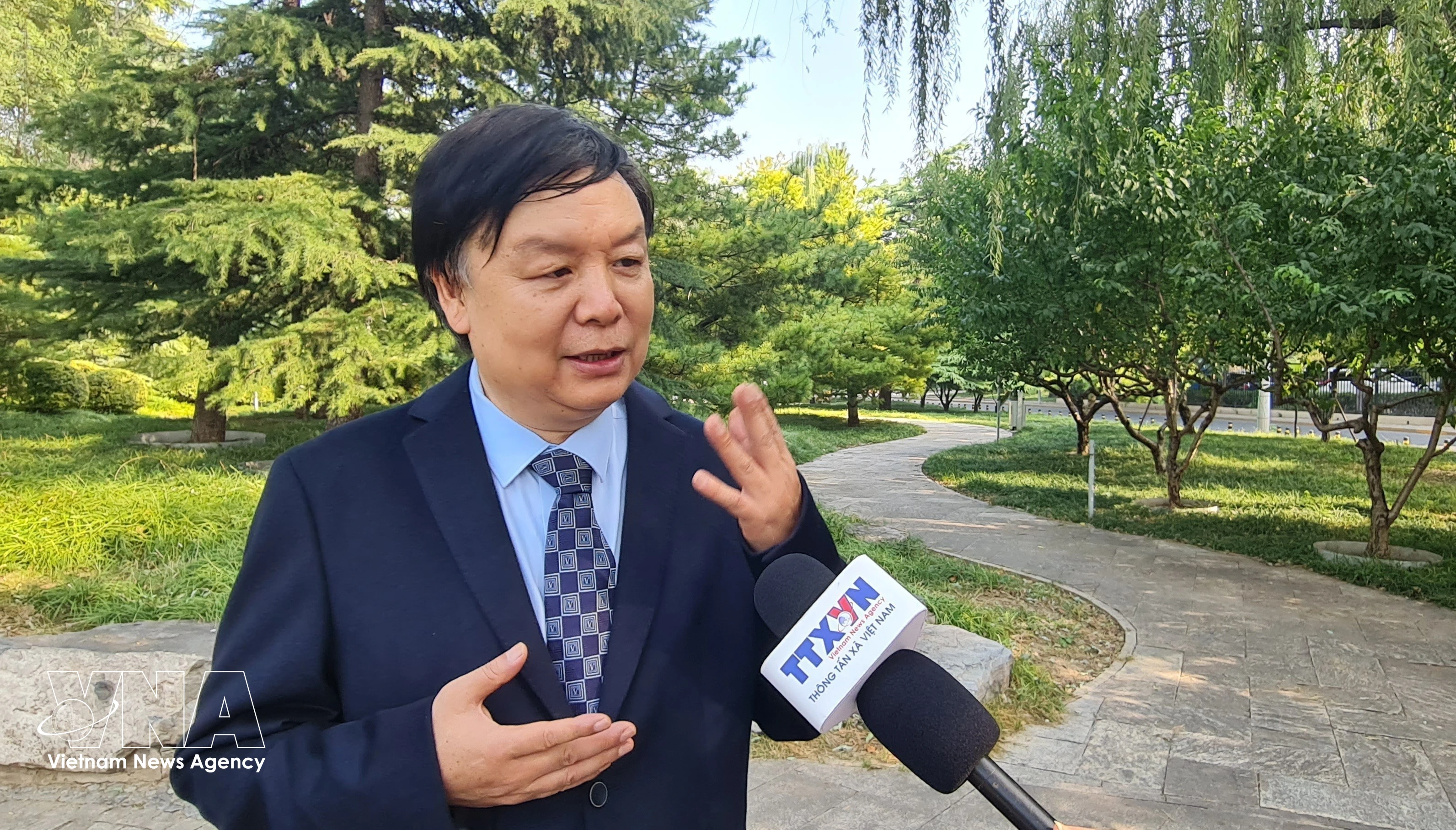
Beijing (VNA) – Parliamentary cooperation between Vietnam and China is helping strengthen political trust, facilitate practical cooperation and advance the building of a community with a shared future between the two countries, according to Chinese scholar Mi Liang.
In an interview with Vietnam News Agency correspondents in Beijing, Professor Mi, Director of the Centre for Southeast Asian Studies at Beijing Foreign Studies University, said relations between the National Assembly (NA) of Vietnam and the National People’s Congress of China (NPC) are flourishing as seen through regular high-level exchanges and increasingly institutionalised cooperation mechanisms.
High-level exchanges have continued to be fostered in recent years. During his visit to Vietnam in April 2025, General Secretary of the Communist Party of China Central Committee and President of China Xi Jinping met with NA President Tran Thanh Man, highlighting the role of the two legislatures in preserving traditional friendship, promoting practical cooperation and strengthening multilateral coordination.
In August 2025, Zhao Leji, Chairman of the Standing Committee of the NPC, met with NA Vice President Tran Quang Phuong in Beijing. In April 2026, General Secretary of the Communist Party of Vietnam Central Committee and President To Lam also met with Zhao during his visit to China.
On institutional cooperation, Mi said the two sides established a cooperation committee between the Vietnamese NA and the Chinese NPC to coordinate exchanges. Regular engagement on legislation and supervision, alongside exchanges between specialised committees and local legislative bodies, has helped expand cooperation across multiple levels and fields.
He described parliamentary ties as an important component of the Vietnam–China Comprehensive Strategic Cooperative Partnership, providing a legal foundation for bilateral cooperation, strengthening political trust and reinforcing the social foundations of relations.
Exchanges on legislation and national governance can help create favourable legal and policy conditions for collaboration in trade, investment and emerging sectors such as the digital economy, new energy and 5G. Closer legislative coordination also contributes to the implementation of the common perceptions reached by the two countries’ leaders, including efforts to connect China’s Belt and Road Initiative with Vietnam’s Two Corridors, One Belt framework, according to the scholar.
Mi also highlighted the scope for cooperation in judicial affairs, anti-corruption and the combat against transnational crime, including telecommunications fraud and online gambling, to help safeguard security and social stability in both countries.
Politically, he went on, parliamentary exchanges complement high-level contacts between the two Parties and countries, providing another channel for discussing regional and international issues and sharing experience in legislation and national governance.
The two legislatures also play an important role in promoting people-to-people ties through parliamentary friendship groups, cooperation between local legislative bodies and activities in education, culture, tourism and youth affairs, helping deepen mutual understanding, particularly among younger generations.
Looking ahead to NA President Man’s official visit to China from October 11 to 15, the professor expressed his hope that the trip will enhance parliamentary cooperation and advance the building of the Vietnam–China community with a shared future.
He said the visit could help consolidate strategic trust, maintain regular high-level mutual visits and step up the implementation of the bilateral parliamentary cooperation mechanism, including exchanges between specialised committees and local legislative bodies.
The two sides could also discuss practical cooperation in railway connectivity, agriculture, electricity, critical minerals and science – technology, while identifying relevant legal and policy requirements to facilitate joint projects.
For future cooperation, Mi proposed further improving exchange mechanisms, strengthening the role of the parliamentary cooperation committee and regularly reviewing the implementation of cooperation agreements. He also called for closer legislative coordination in key economic sectors, stronger cooperation in combating transnational crime and ensuring cybersecurity, and more legislative forums to share experience in lawmaking and national governance.
In people-to-people ties, he advocated expanding exchanges among young people, social organisations, and educational and cultural institutions to strengthen the social foundations of bilateral relations.
At the multilateral level, he suggested closer coordination between the two legislatures at international and regional parliamentary forums, including the Inter-Parliamentary Union (IPU) and the ASEAN Inter-Parliamentary Assembly (AIPA), on issues of shared concern and in safeguarding the common interests of developing countries.
Mi said parliamentary diplomacy could further contribute to peace, cooperation and stability in the region.
Stronger cooperation between the Vietnamese NA and the Chinese NPC is expected to help consolidate political trust, expand practical collaboration, promote people-to-people links and reinforce the institutional foundations for the stable and long-term development of bilateral relations, he added./.