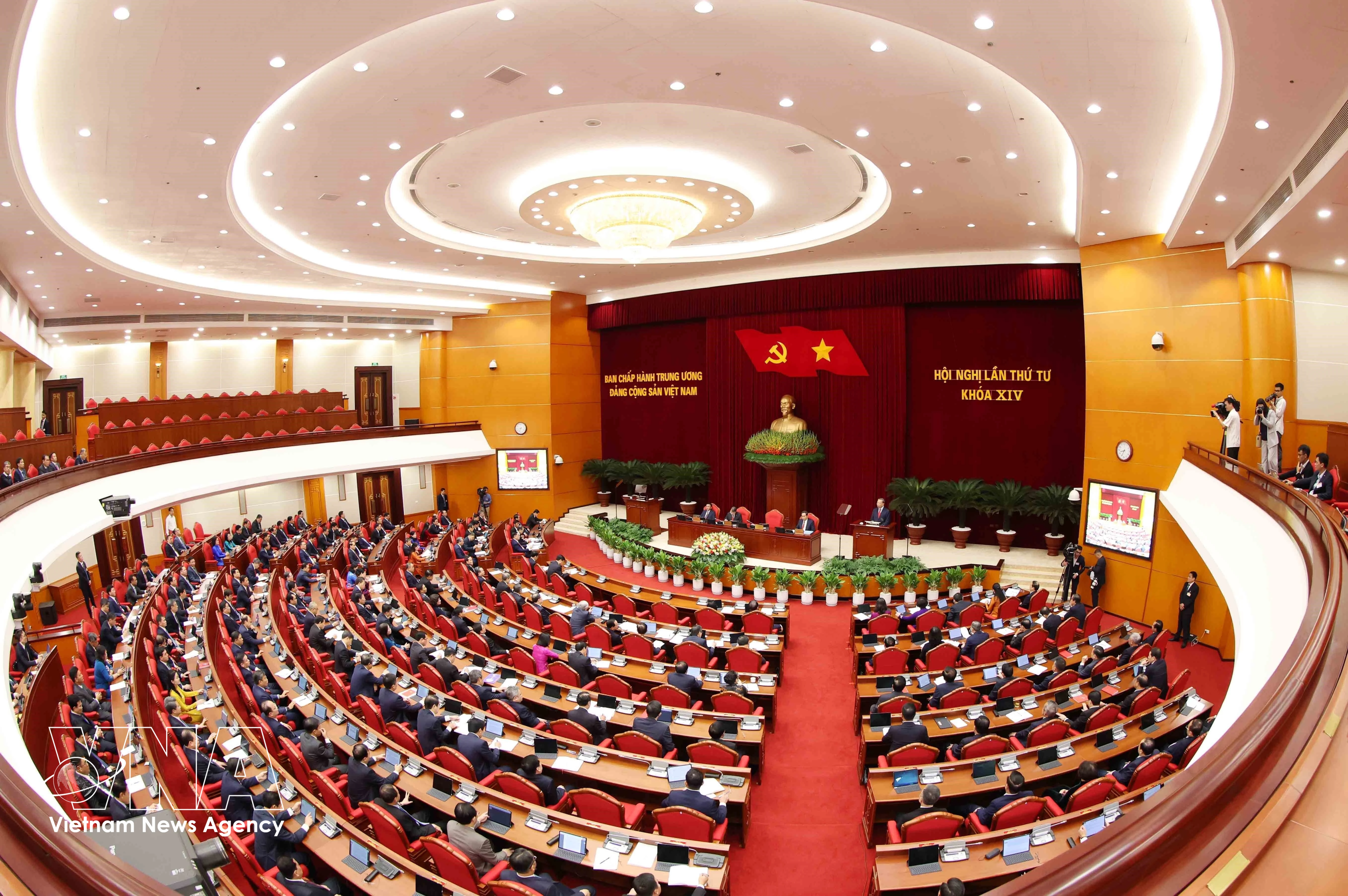
Hanoi (VNA) – General Secretary of the Communist Party of Vietnam (CPV) Central Committee and President To Lam opened the fourth plenum of the 14th CPV Central Committee on October 5 by setting four areas for discussion, including the right priorities for 2027 and how to use national resources to drive rapid, sustainable development.
The Party and State leader said 2027 must be a year of acceleration, breakthroughs and profound changes that builds momentum for the goals of the full term. He urged the committee to scrutinise the main targets and solutions, in particular what it will take to achieve GDP growth of 10% or higher and inflation of around 4.5%.
The committee must identify the breakthroughs needed to turn resources into productive capacity, business performance and tangible results. Institutional bottlenecks must be cleared, the economy's capacity to absorb capital improved, and infrastructure, energy and labour secured.
If 2026 is the first year of the 2026-2030 five-year plan, 2027 targets must be built to deliver sharper gains in pooling and using resources efficiently.
Growth remains the consistent priority, with the aim of double-digit expansion while maintaining macroeconomic stability, controlling inflation and preserving major economic balances.
Under this orientation, ministries, agencies and localities must fix development institutional mechanisms and push breakthroughs in lawmaking and enforcement to unlock investment, production and trade. Other key tasks include further slimming the State apparatus, raising the quality of officials and civil servants, tightening discipline and curbing corruption and wastefulness.
In science, technology and innovation, ministries and agencies must keep reviewing and upgrading policies for breakthroughs while prioritising skilled labour in strategic fields, including artificial intelligence, big data, semiconductor chips, cybersecurity and next-generation digital technologies.
On infrastructure, the focus is on speeding up key works, nationally important projects and strategic inter-regional links to create new growth drivers.
Drafting the 2027 socio-economic plan is more than an annual task for ministries, agencies and localities. It is a step toward the goals for the entire 2026-2030 period, and its quality will determine whether major policies translate into concrete results and lay the groundwork for high, sustainable growth.
Setting the right growth target for 2027 is especially important.
Vietnam's GDP grew 9.01% in the first nine months of 2026, and fourth-quarter growth must exceed 12.5% to meet the annual target. The 2027 goal must therefore be set precisely to keep the five-year plan on track and preserve momentum, without complacency or undue haste.
Breakthroughs are needed in several areas to turn resources into economic capacity in 2027:
Institutional enforcement: Laws and policies must be amended promptly and vested and sectional interests eliminated. Responsibility must be tied to implementation timelines, lead agencies and deadlines clearly named, and effectiveness gauged by tangible benefits to citizens.
Officials' ability to deliver results: Delegated authority must come with accountability, and real powers with the resources to use them. Collective and individual responsibilities must be clearly delineated and buck-passing prevented. Officials who dare to think and act in the common interest must be protected, while stagnation and fear of responsibility are dealt with strictly.
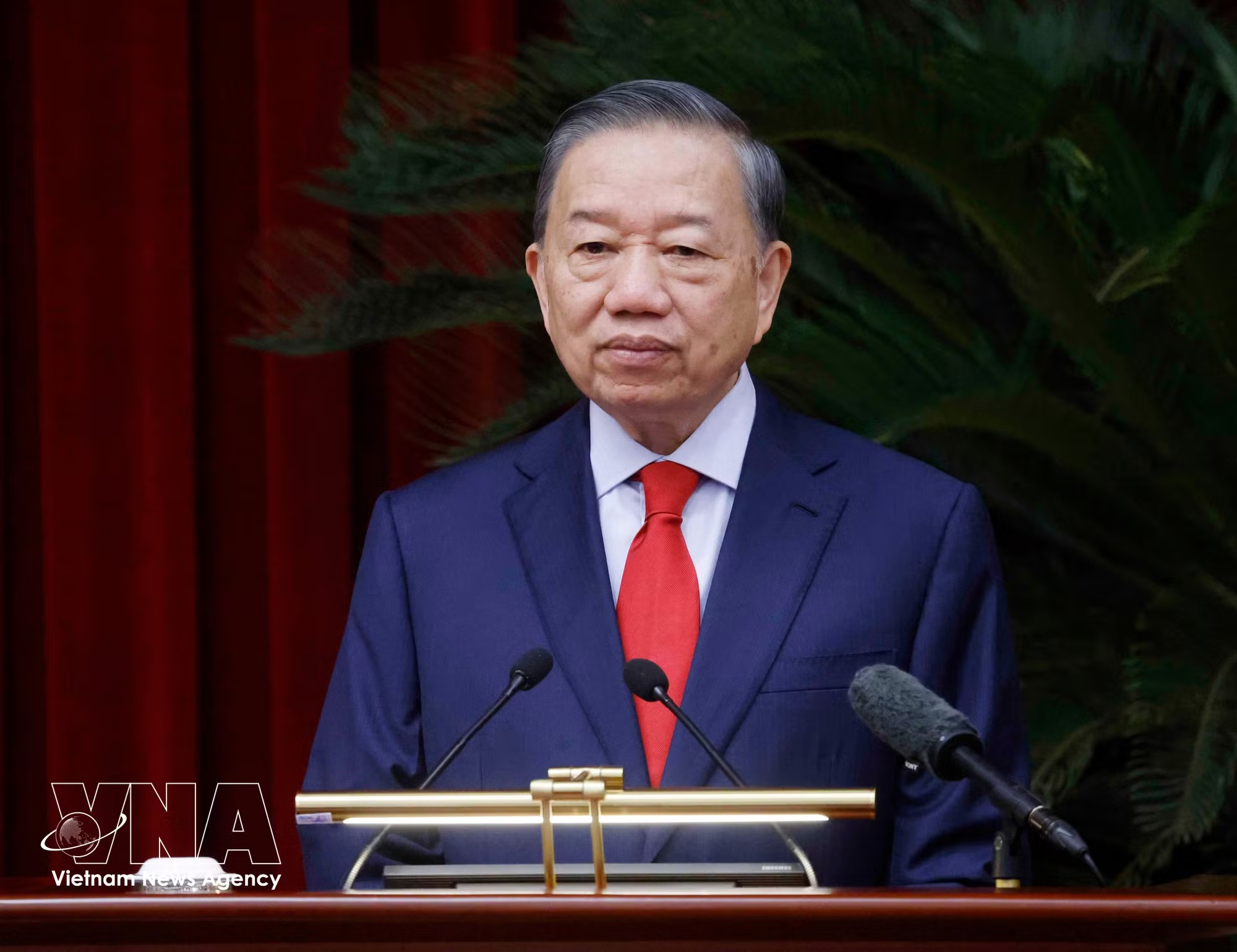
Science, technology, innovation and digital transformation: Productivity must improve in substantive terms, and technology must be used to bolster enterprises' autonomy and capabilities. Digital ecosystems must be built in governance and production, links among research institutes, universities and businesses tightened, and technology experts and strategic talent attracted.
Public investment and business health: Disbursement of public investment must be accelerated and the bottlenecks behind slow spending at ministries and agencies fully cleared. Investment capital must be converted into real production capacity and output. Domestic producers must be backed by stronger technological capabilities, trade deficits minimised and domestic value added in supply chains higher.
Leveraging resources effectively, as the leader put it, means unlocking, pooling, allocating and making optimal use of the economy's inputs to create drivers of rapid, sustainable growth.
First, investment capital must be freed up. That means clearing bottlenecks holding up thousands of projects, speeding public investment disbursement and drawing capital from across society, including foreign direct investment (FDI) and public resources, into production and trade rather than leaving funds idle.
Next, the workforce must be upgraded by raising the share of trained workers, promoting digital knowledge and technological skills, and tapping overseas Vietnamese and experts to build the labour force that new forms of production require.
Innovation and digital transformation must advance through higher spending on research and development (R&D), growth of the digital and data economies, and a bigger contribution from total factor productivity (TFP) to economic growth.
Policies and mechanisms must be transparent, the business climate improved, the "ask-give" mechanism eliminated, corruption curbed and national governance capacity strengthened.
Resources must also be used more efficiently as Vietnam pursues green growth, through better use of land, water and minerals, promotion of clean energy and circular economy, and lower energy consumption per unit of GDP.
Vietnam's economic resources are generally not being used to their full potential.
Several bottlenecks undermine efficiency, including high investment needs and a high incremental capital-output ratio (ICOR), meaning large amounts of capital yield relatively low returns; a low share of trained workers and severe shortages of highly skilled personnel and technology engineers, R&D spending that is modest relative to GDP, insufficient support for the private sector, and heavy reliance on FDI.
Contributing factors include institutional bottlenecks, with overlapping legal regulations slowing capital flows and complicating access to and use of land, as well as inadequate, poorly integrated infrastructure that keeps logistics and operating costs high across the economy.
If resources are not fully utilised, Vietnam risks falling into the middle-income trap, with slower growth and large investment volumes producing relatively little output. Labour productivity and the TFP contribution could fall short of expectations, making double-digit growth harder to reach./.