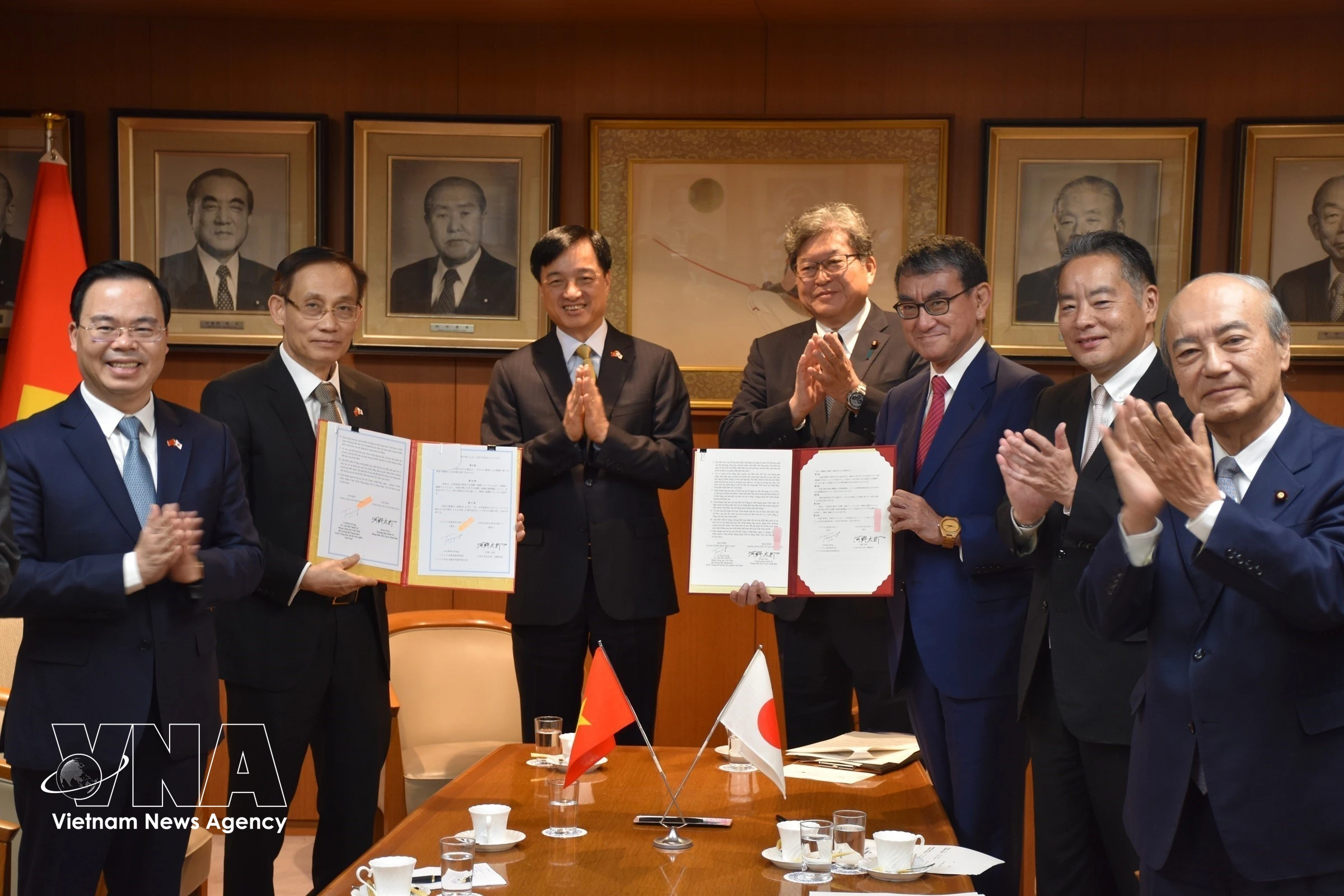
Tokyo (VNA) – Le Hoai Trung, member of the Political Bureau of the Communist Party of Vietnam (CPV) Central Committee and Minister of Foreign Affairs, and Kono Taro, Director-General of the International Bureau of the Japan’s Liberal Democratic Party (LDP), signed a cooperation memorandum between the two parties in Tokyo on November 11.
The signing was witnessed by Nguyen Duy Ngoc, member of the Political Bureau, Secretary of the CPV Central Committee and Chairman of its Organisation Commission, and Hagiuda Koichi, Executive Acting Secretary-General of the LDP. It took place during the official visit to Japan by General Secretary of the CPV Central Committee and President To Lam.
Talking to Hagiuda, Ngoc, who is also head of the Vietnam–Japan Parliamentary Friendship Group, hailed the Vietnam–Japan Comprehensive Strategic Partnership and welcomed the “Vietnam–Japan Joint Vision Statement: Partners Advancing Together and Co-creating for Mutual Benefit, High-quality Growth, Strategic Autonomy and Resilience” freshly adopted by the two countries’ sernior leaders.
He described Japan as a leading and long-term partner of Vietnam, noting that the development of each country serves as a prerequisite and driving force for the other.
The new memorandum provides an important basis for expanding exchanges and cooperation between the two parties, helping promote the Vietnam–Japan Comprehensive Strategic Partnership in a more substantive manner, and translating the agreements reached by their senior leaders into practical results, Ngoc said.
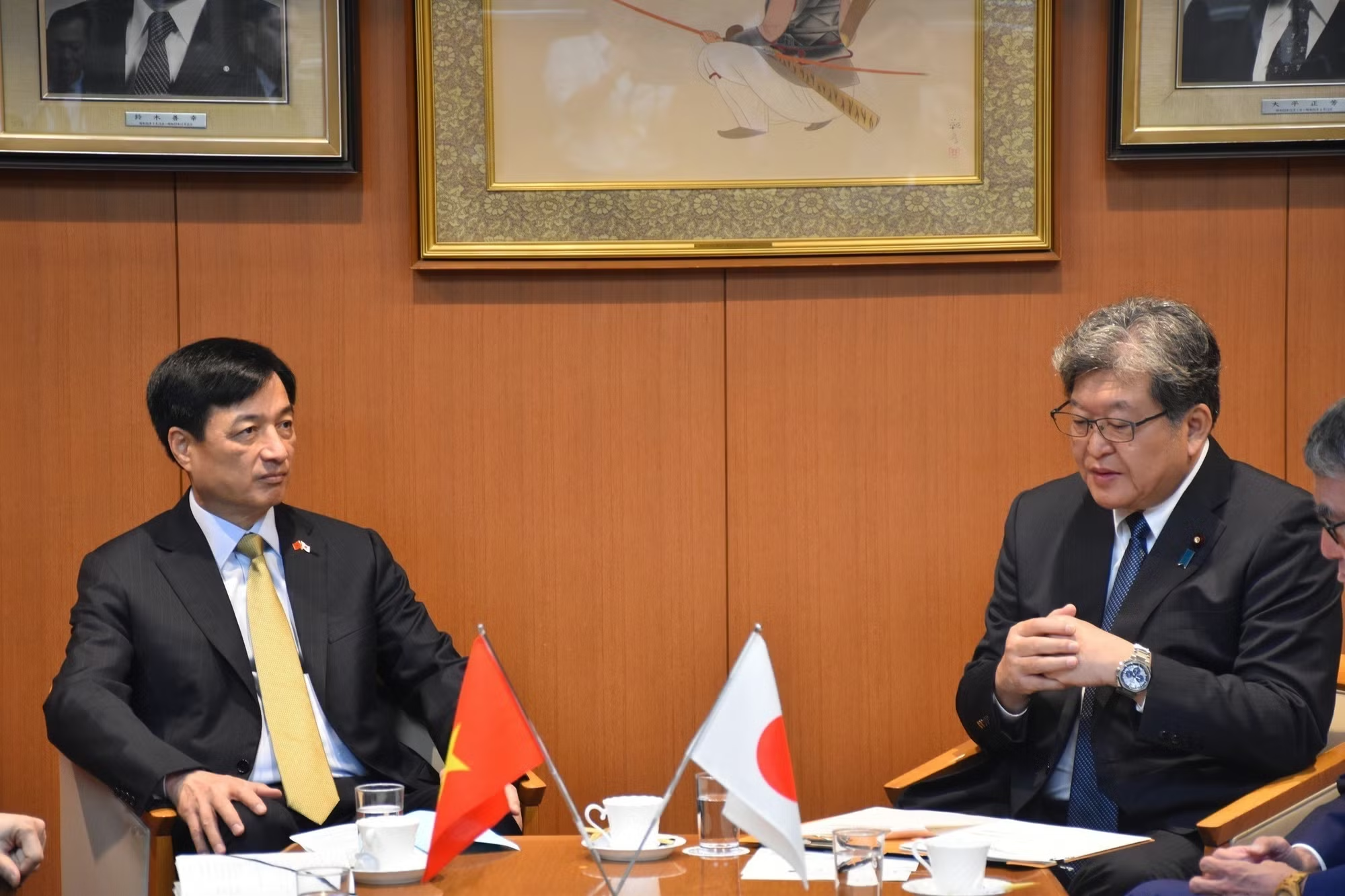
Nguyen Duy Ngoc, member of the Political Bureau, Secretary of the CPV Central Committee and Chairman of its Organisation Commission (left), meets with Hagiuda Koichi, Executive Acting Secretary-General of the LDP, in Tokyo on November 11, 2026 (Photo: VNA)
Under the memorandum, the two parties will promote exchanges between their specialised departments to share information and experience in policy-making and governance. They also plan to organise the first policy dialogue between these departments during a visit to Japan by the head of the CPV Central Committee’s Policy and Strategy Commission in November 2026.
Other priorities include training programmes for strategic-level and young officials, and stronger economic, trade and investment cooperation. The two sides will also encourage businesses to expand collaboration in science, technology, innovation, digital transformation, green transition and sustainable development.
Both sides expressed their satisfaction with the signing of the new memorandum of understanding, which builds upon an agreement that has been effectively implemented since 2015, marking a new stage in bilateral cooperation. They agreed to bolster relations between the two parties, parliaments, and peoples while also facilitating engagement between the youth of both parties and countries.
Also on November 11, Ngoc visited and held a working session with the National Graduate Institute for Policy Studies (GRIPS), where he met its President Ota Hiroko and other leaders.
Ota said the institute has helped train 240 Vietnamese officials and is currently providing training for 12 others. Since 2018, under a programme entrusted by the Japan International Cooperation Agency (JICA), it has provided short-term courses for 454 strategic-level officials from Vietnam and long-term training for 41. The programmes combine policy studies with practical research and field visits while helping participants develop policy analysis and planning skills.
Ngoc thanked the institute for its contribution to developing Vietnam’s human resources and strengthening friendship between the two countries. He said education – training is among the most important pillars of bilateral cooperation, alongside strategic fields such as science – technology, artificial intelligence, digital transformation, green transition and aerospace.
He proposed further cooperation in designing a one-year master’s programme, training lecturers in public policy, and sharing Japan’s experience in developing and managing public-sector human resources.
Ota welcomed the proposals and expressed her hope that the two sides will expand collaboration in training and capacity building for Vietnamese officials./.