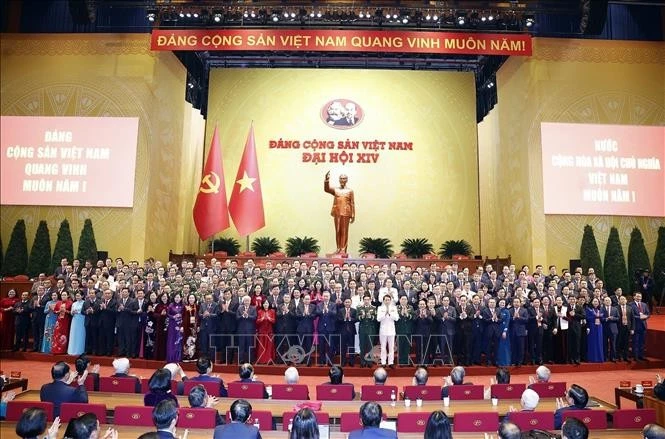
Havana (VNA) – The 14th National Congress of the Communist Party of Vietnam (CPV) demonstrated the stability and continuity of political leadership in advancing the Party’s set goals, according to Dr Ruvislei González Saez, senior researcher at the Cuban Centre for International Policy Research (CIPI), in a recent article published on reporteasia.com.
In the article, the Cuban scholar stressed that the congress showed Vietnam’s ability to ensure personnel and leadership work alongside a vigorous anti-corruption campaign, thereby maintaining not only political stability but also the Party’s historical legacy. He noted that a key factor distinguishing Vietnam’s political process is its collective leadership and generational succession based on the principles laid down by the late President Ho Chi Minh. According to him, at the 14th Congress, delegates unanimously adopted its Resolution, reaffirming the core contents of the review of the implementation of the 13th National Party Congress Resolution, assessing several theoretical and practical issues related to the socialist-oriented Doi Moi (renewal) process over the past 40 years, and evaluating 15 years of implementation of the Party Statutes (2011–2025).
Marking the 40th anniversary of this important process, Vietnam has demonstrated that reform must be continuous and uninterrupted, advancing through successive new stages. At the same time, the transition from a highly centralised and bureaucratic model to a socialist-oriented market economy has been comprehensive, closely linking key elements of the economy, diplomacy, security, and national defence toward a single goal of promoting national development.
From theory to practice, Vietnam’s transformations have demonstrated the existence and necessity of socio-economic diversity as a vital process, combined with the dynamism of the market economy oriented toward socialism, in which the State plays a pivotal role as a regulatory lever of economic mechanisms. It is therefore no coincidence that in this new phase, all economic sectors, including the private sector, are prioritised as key drivers for achieving the development goals set for 2030 and 2045.
In reviewing the country’s current development stage, the 14th Congress set the objective of transforming Vietnam into a developing country with modern industry and upper-middle income by 2030, and realising the vision of becoming a developed, high-income country by 2045. In other words, Vietnam aspires to reach its highest level of development by the centenary of its independence.
Ruvislei praised key development indicators established by the 14th Congress for the 2026–2030 period, which include an average annual GDP growth rate of 10%, GDP per capita of around 8,500 USD by 2030, manufacturing and processing industries accounting for about 28% of GDP, and the digital economy contributing approximately 30% of GDP.
According to the scholar, the Congress reflects the country’s determination to move into a new stage of development amid a complex and unstable international environment. Through this event, Vietnam reaffirmed the importance of continuous transformation and the necessary pragmatism not only in its foreign relations strategy but also in governance, management, and national leadership./.