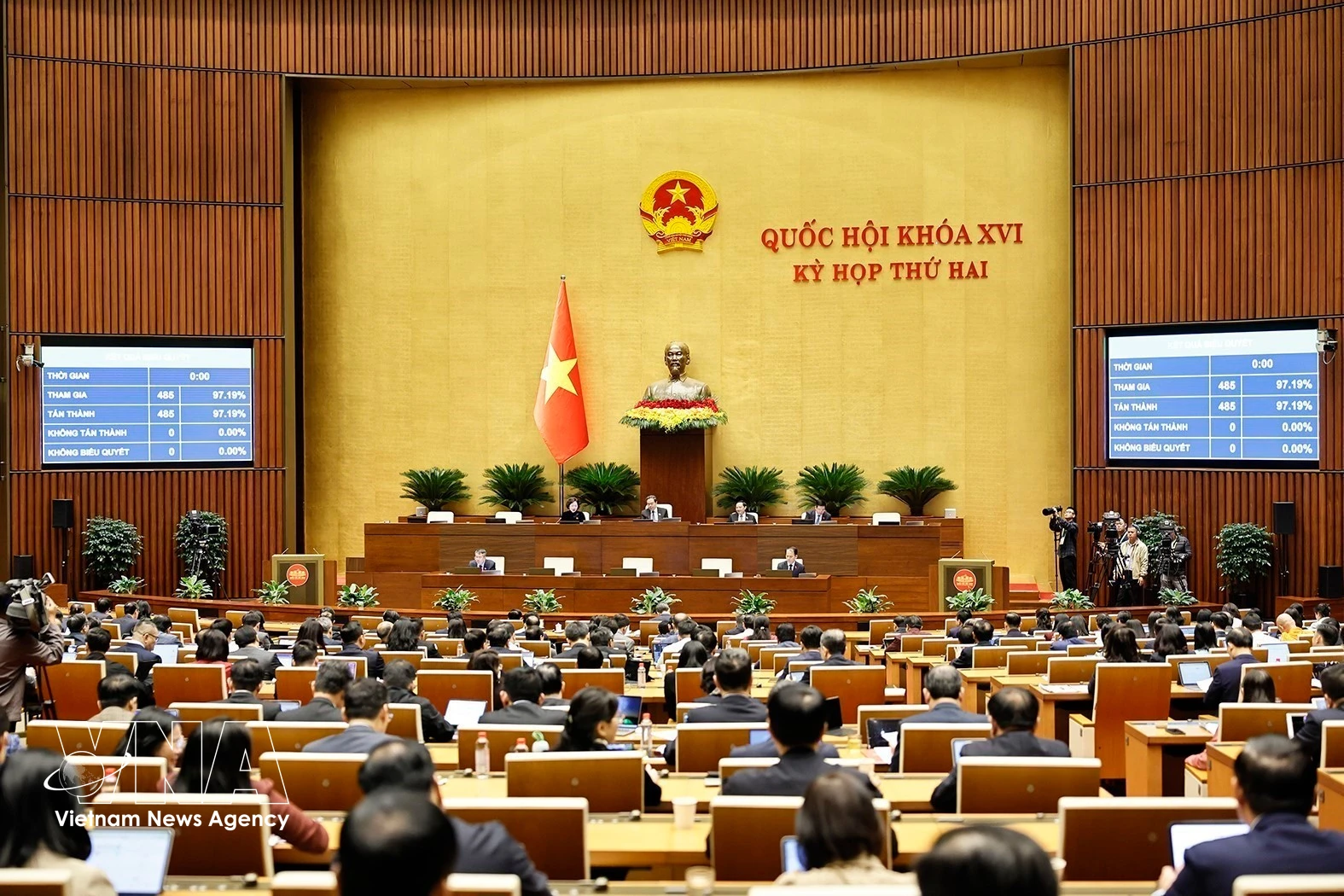
Hanoi (VNA) – The 16th National Assembly (NA) on November 20 passed the Law on Small- and Medium-sized Enterprise Development with unanimous approval from all 485 deputies present.
Presenting the Government’s report on the explanation and incorporation of lawmakers’ feedback and revisions to the draft law, Minister of Justice Hoang Thanh Tung said the criteria for identifying small- and medium-sized enterprises (SMEs) had been carefully reviewed to ensure feasibility, stability and ease of application, drawing on more than 25 years of policy implementation and international practices.
The Government will provide detailed guidance on applying these criteria to newly established businesses, enterprises operating in multiple sectors and those with seasonal workers or changing business scales. The regulations will make use of existing administrative data and avoid requiring businesses to resubmit information already available to State agencies.
The law comprises four chapters and 32 articles and will take effect on July 1, 2027.
In the same morning, the legislature passed the amended Law on Property Auction, with 475 of the 482 deputies present voting in favour.
Regarding advance deposits, the revised law authorises the Government to set specific levels within the statutory framework, taking into account the characteristics of different assets and local conditions. The Government proposed retaining deposits equivalent to 20-50% of the starting price for auctions of land use rights for residential land allocation to individuals, aiming to curb abnormally high bids followed by deposit forfeiture.
The law also stipulates that auction participants are deemed to accept the announced starting price, helping prevent collusion and deliberate disruptions that could render auctions unsuccessful and depress asset prices. Where multiple participants accept the starting price without higher bids, lots will be drawn to ensure transparency and fairness.
For online auctions, the law leaves the specific starting-price threshold for mandatory online bidding to Government regulations, ensuring flexibility in line with infrastructure capacity and practical conditions.
The amended Law on Property Auction consists of seven chapters and 66 articles and will also take effect on July 1, 2027./.