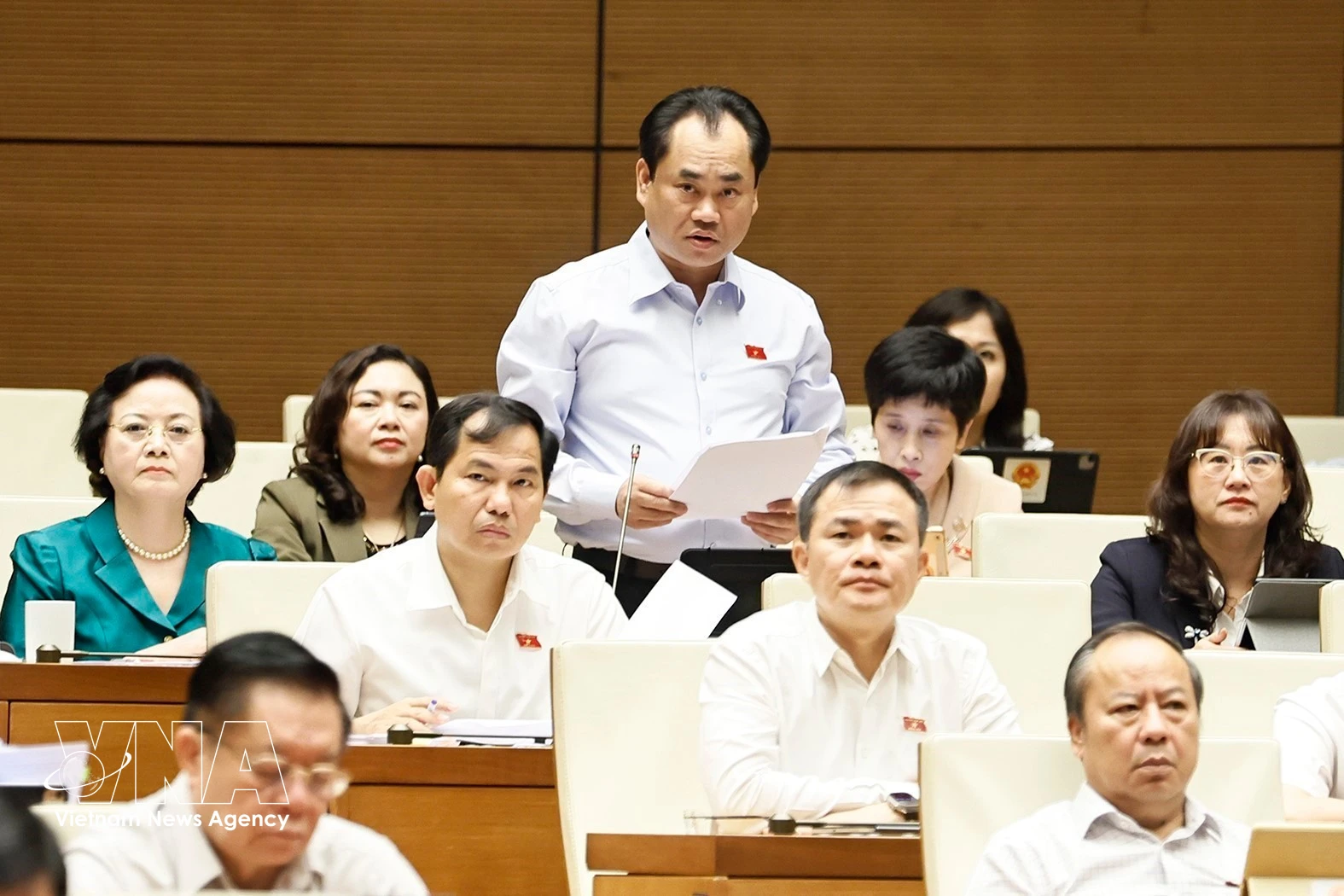
Hanoi (VNA) – Minister of Agriculture and Environment Trinh Viet Hung addressed several parliamentary concerns, ranging from biotechnology development to funding shortfalls in climate adaptation infrastructure, on October 31 as part of the ongoing second session of the 16th National Assembly.
Bridging policy and execution in biotechnology
Responding to opinions raised by deputy Nguyen Thi Lan of Hanoi regarding synthetic biotechnology, Hung noted that in line with the Politburo’s Resolutions No. 57-NQ/TW and No. 36-NQ/TW, alongside the Prime Minister’s Directive No. 13/CT-TTg, his ministry has proposed key regulatory frameworks. Notable among these are the Prime Minister’s Decision No. 1639/QD-TTg, approving the bio-industry development scheme in environmental protection through 2030, and Decision No. 1466/QD-TTg, targeting the agricultural sector.
While the conditions regarding institutional frameworks, facilities, personnel, and technology are basically sufficient, the fundamental challenge now lies in rigorous implementation, he emphasised.
Over the past six months, the ministry has commissioned the Vietnam National University of Agriculture to execute two scientific and technological tasks with bio-technological components. Simultaneously, research tasks, including those in biotechnology, have been assigned to scientists, institutes, universities, and research centres nationwide.
Moving forward, the ministry will continue to coordinate with agencies, sectors, localities, institutes, and universities to advance this field, he added.
Substantial capital shortfalls in disaster prevention
Fielding queries on natural disaster prevention, climate change adaptation, and agricultural infrastructure investment to mitigate disaster impacts, the minister noted that for the Mekong Delta, central authorities allocated approximately 40 trillion VND (1.5 billion USD) for the 2021–2025 period. For 2026–2031, total funding has reached 23.5 trillion VND, comprising 15 trillion VND from the Prime Minister’s allocation and 8.5 trillion VND in official development assistance (ODA).
This represents a major financial resource earmarked for the Mekong Delta to execute tasks combating erosion, land subsidence, flooding, drought, and saltwater intrusion through 2035, as directed under the Politburo’s Conclusion No. 26-KL/TW.
However, Hung acknowledged that capital supply for disaster prevention works still falls short of actual demand. Nationwide capital demand for disaster prevention and control, including erosion, subsidence, drought, and saltwater intrusion in the Mekong Delta, as well as heavy rains and flash floods in the North, is estimated at approximately 210 trillion VND, whereas the central budget capacity can currently cover only half of this requirement, at about 105 trillion VND.
With regard to specific concerns raised by deputy Ha Sy Huan of Thai Nguyen province following the severe impacts of Storms Bualoi and Matmo in the North, including Thai Nguyen, last year, the minister clarified the status of the Cau River flood control project.
It was initially approved as three urgent projects, with construction commencing only several months later in early 2026. Consequently, for the 2026–2031 period, funds designated for urgent projects can no longer be used for these works; instead, funding must follow the standard medium-term public investment planning process.
Furthermore, he went on, under the Law on Public Investment, for projects where investment policies are approved at the provincial level, capital allocation falls under the authority of the Ministry of Finance rather than the Ministry of Agriculture and Environment.
Meanwhile, key structural works, including the Cau River dyke, Cha dyke, and Thac Huong dam, have already secured medium-term funding allocations in compliance with statutory provisions, Hung added./.