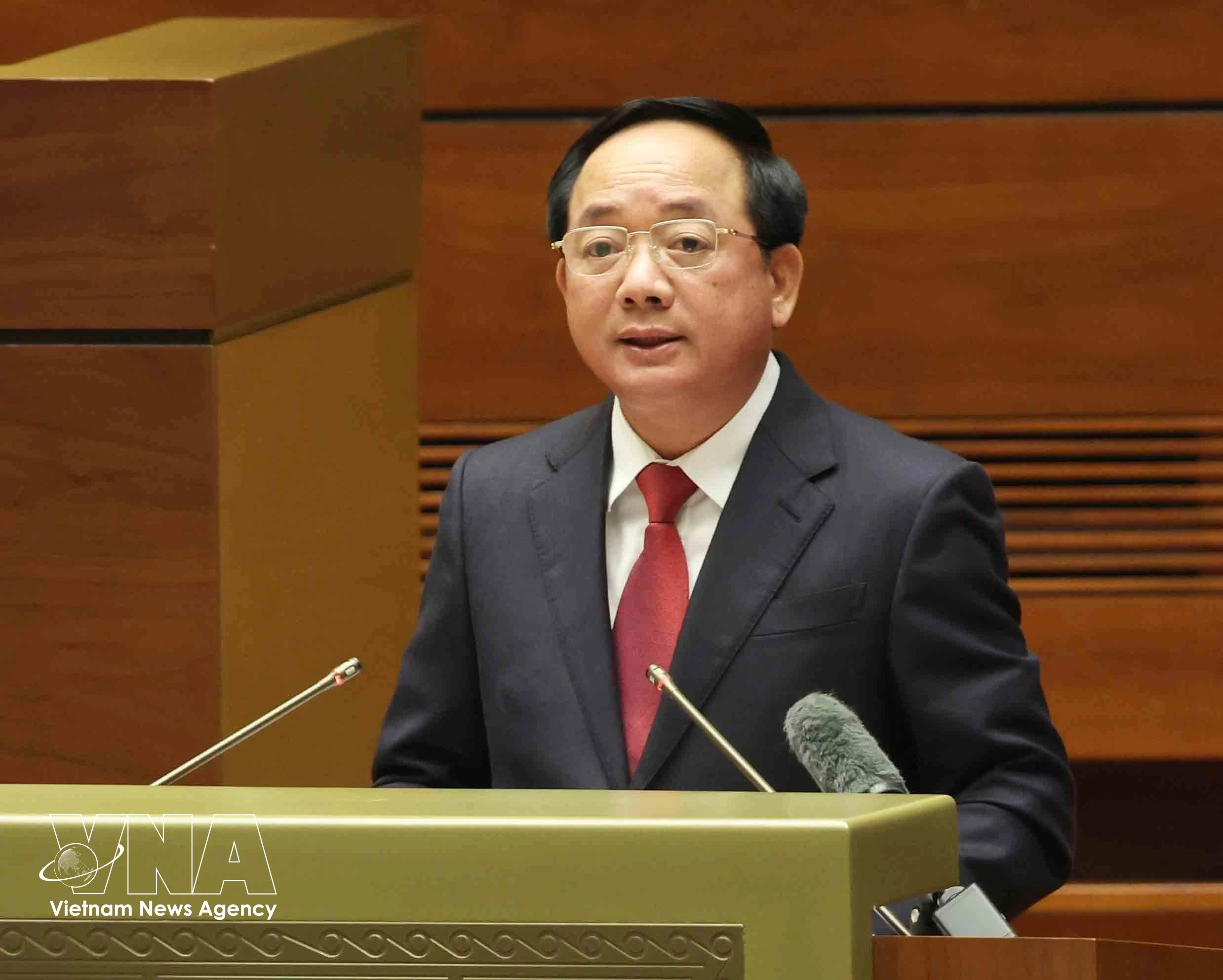
Hanoi (VNA) – Politburo member, Secretary of the Party Central Committee and Chairman of its Commission for Information, Education and Mass Mobilisation Trinh Van Quyet presented key contents of the newly issued regulation on political and ideological work within the Party at a national conference on April 13.
The regulation, adopted at the second plenum of the 14th Party Central Committee and issued as Regulation No. 19-QD/TW on April 8, 2026, marks the first comprehensive and systematic framework governing political and ideological work in the Party. It reflects a new step in theoretical mindset and strong political resolve to enhance Party building as well as the Party's leadership and combat capacity.
According to Quyet, the regulation specifies the spirit of the 14th National Party Congress, shifting from general orientation to binding rules with clearly defined principles, responsibilities, methods, and mechanisms for inspection and supervision.
A key highlight of the regulation is that, for the first time, political and ideological work is approached as a governance system with defined objectives and criteria, capable of being quantified, measured, monitored, and held accountable. It goes beyond an internal regulatory document to represent a strategic elevation in Party building in terms of political and ideological work, serving as a foundation to strengthen public trust, reinforce the nation's internal strength, and meet the requirements of rapid and sustainable development in the country’s new era of advancement.
Structured into five chapters and 16 articles, the regulation applies to all Party organisations and members without exception, making political and ideological work a mandatory task. It seeks to strengthen political steadfastness, unity in thought and action, and public trust, while preventing ideological degradation, “self-evolution” and “self-transformation”.
The regulation underscores the principle of maintaining core ideological commitments while promoting innovation, proactive leadership, and adaptability in the digital era.
It expands the scope of political and ideological work from one-way communication to active guidance and shaping of public perception, including on digital platforms. Emphasis is placed on applying modern technologies, digital transformation and data systems to monitor, analyse and forecast public opinion, especially online.
The regulation clearly defines responsibilities, in which Party committees hold overall accountability, while heads of organisations bear direct and highest responsibility. Party members are required to act as proactive agents in promoting positive values and countering false and hostile views.
Inspection and supervision must be conducted regularly and rigorously, with strict handling of violations and timely recognition of good performance. The regulation also calls for integrating political and ideological work into all aspects of Party building, including organisation, personnel, inspection and mass mobilisation.
It also underlines the need to strongly and comprehensively renew methods of political and ideological work in a modern, scientific and effective direction, with a focus on accelerating the application of digital technologies, artificial intelligence and big data. Proactively provide official information in a timely and accurate manner, leaving no information gaps for false or hostile narratives to take hold, thereby maintaining initiative and securing an advantage on the ideological front.
Quyet stressed that effective implementation is decisive, requiring urgent, substantive and result-oriented actions. He urged Party organisations and members to move from “studying resolutions” to “acting on them”, with measurable outcomes as the ultimate benchmark.
The regulation is expected to serve as a crucial institutional and spiritual foundation for building a clean, strong Party capable of leading the country’s development in the new era./.