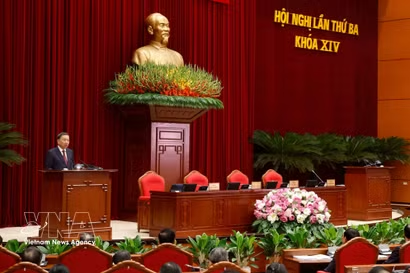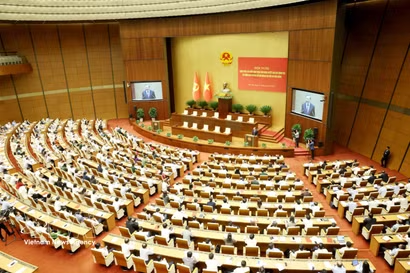
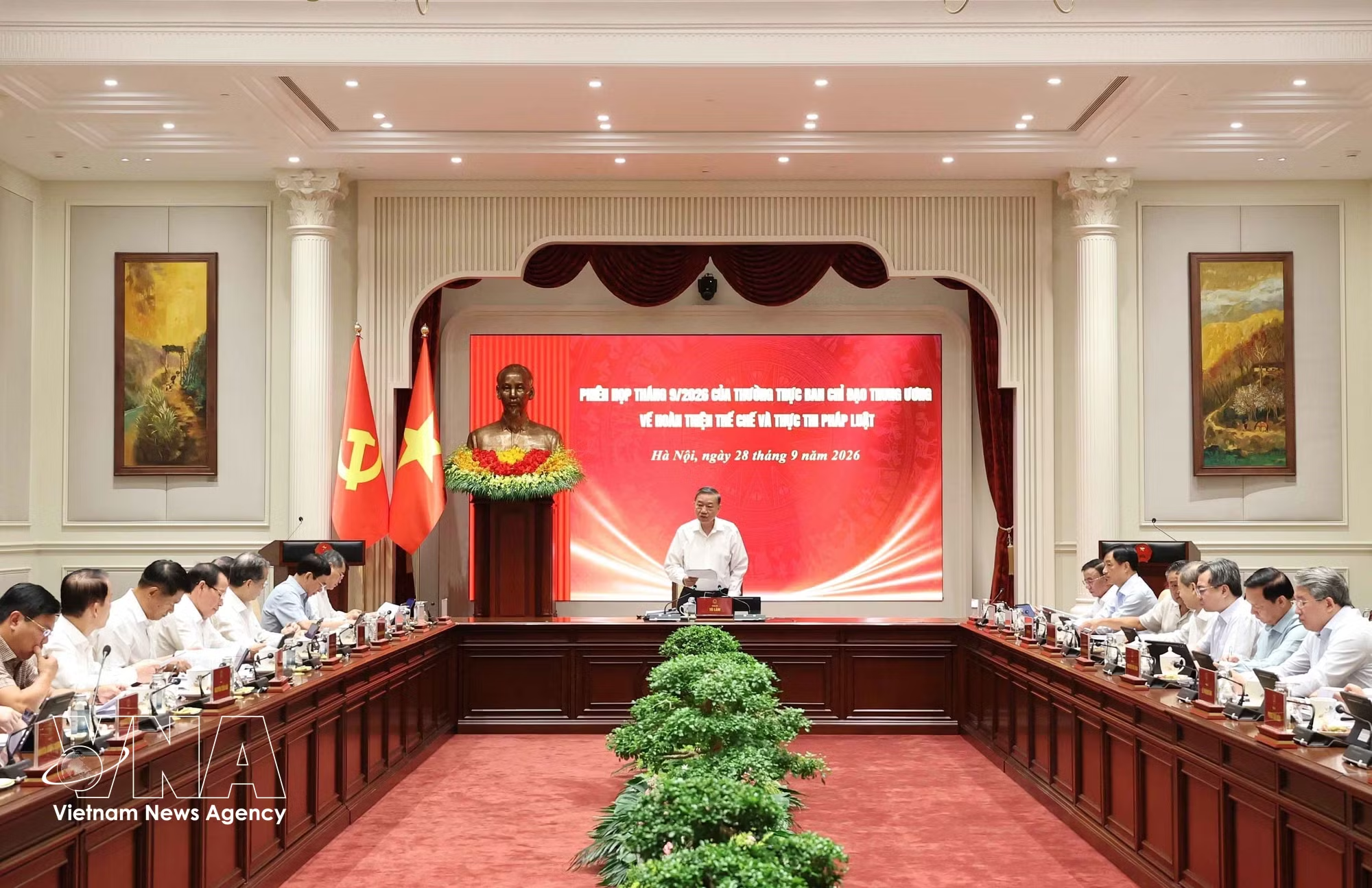
Hanoi (VNA) – Almost four years have passed since the 13th Communist Party of Vietnam (CPV) Central Committee issued Resolution 28-NQ/TW on November 17, 2022 on continuing to innovate the Party's leadership and ruling methods over the political system in the new period, General Secretary of the CPV Central Committee and President To Lam told an August 20 meeting reviewing the resolution's results that reform must target key areas, make implementation the breakthrough and judge success by tangible outcomes.
The resolution sets the overall goal of creating strong and substantive changes in the Party’s leadership methods toward the political system. It seeks to strengthen the Party's governing capacity, secure comprehensive and effective leadership, and shift working methods toward a more scientific, democratic approach grounded in reality.
Overhauling the Party’s leadership methods is an objective, inevitable and urgent requirement to elevate the Party’s governing capacity and combat strength and keep the political system effective in the new development era.
In renewing the Party’s leadership methods today, it is necessary to clearly identify the priorities rather than pursue scattered and unfocused reforms. Resources and time should go to core areas and the biggest bottlenecks.
The main focus, he said, is implementation. Officials have tended to underestimate the rollout stage, and he wants Party resolutions and directives turned into reality rather than left on paper.
Even a well-designed policy delivers nothing to the public if its execution is slow or ineffective. The ability to turn decisions into action is the main determinant of whether the leadership overhaul succeeds.
The problem of "good resolutions, poor rollout" persists. Some officials stay hesitant and choose "safe" approaches, putting "not making mistakes" ahead of the quality of services delivered to citizens and businesses.
Inspection, supervision and mechanisms for dealing with inertia are also weak in many agencies and units to improve public service discipline in any substantive way.
Using tangible results as the yardstick means organisations' capacity, the administrative apparatus' effectiveness and officials' credibility should not be judged on appearances, reports or the number of resolutions issued. The review must instead weigh actual outputs, work quality, and the satisfaction and benefits delivered to the public.
The approach is meant to tackle formalism and the gap between words and action, so that every policy, resolution or task generates real value for society.
Reforms without substance carry costs. They can distort Party decision-making, waste State resources and erode public trust.
Artificially strong results can produce flattering figures that misrepresent reality and lead leaders to misjudge the situation. Policies built on a false foundation are likely to fail.
The resolution is closely tied to Resolution 26-NQ/TW, adopted by the 12th CPV Central Committee on May 19, 2018. That earlier measure focuses on building a contingent of officials at all levels, especially at the strategic level, whose qualities, capacity and credibility match their responsibilities.
If tangible results are to be the benchmark for the leadership overhaul, officials must likewise be assessed on performance reflected in concrete outputs.
One remedy for "talking more and doing less" is to tie results to officials' responsibilities under the principle of "clear roles, tasks, responsibilities and outputs." Concrete outputs and actual effectiveness will become the key criteria for assessing both organisations and individuals.
Weak measurement and verification of work results invite across-the-board ratings and leniency. They also give an inaccurate picture of the workforce's real quality.
Many agencies and units have yet to set specific criteria, benchmarks or outputs that turn performance into quantitative data. Assessments rely largely on general comments, and the results are often formalistic. They are not consistently used as the core basis for personnel planning, appointment, deployment or weeding out underperformers.
Assessment based on concrete outputs should replace vague qualitative judgments with data-driven measurement. Difficult tasks can serve as a test of capacity, judged by bottlenecks cleared, complex projects completed on time, satisfaction among organisations and citizens, and the rate of cases handled effectively.
The five-year review of the Resolution 28-NQ/TW is meant to objectively assess achievements, identify shortcomings and set directions and tasks for the next phase of renewing the Party's leadership and governing methods.
General Secretary and President Lam called for a comprehensive, substantive assessment of results from the central to grassroots levels, covering the periods before and after the restructuring of the organisational apparatus.
He told the review to focus on five major bottlenecks, including the wide gap between Party policies and their enforcement; unclear boundaries in some places between political leadership and State management, and between collective authority and the responsibility of the head; decentralisation and delegation of authority that are not matched by sufficient powers, resources, data and mechanisms for power control; weak capacity for research, forecasting and early warning; and the failure to routinely use data, public feedback and task performance results in leadership and assessment.
He concluded that alongside the achievements, shortcomings need to be seriously identified and tackled. The quality and structure of the contingent of officials remain problematic, and highly capable officials and leading experts are in short supply in several strategic fields. Grassroots officials' quality is inadequate in some places. Some officials' forecasting, strategic thinking, modern governance, digital transformation and innovation skills have yet to keep pace with the new situation. Personnel assessment remains a weak link and has not brought fundamental changes, while quantifying and verifying work outputs, results and effectiveness remain limited./.