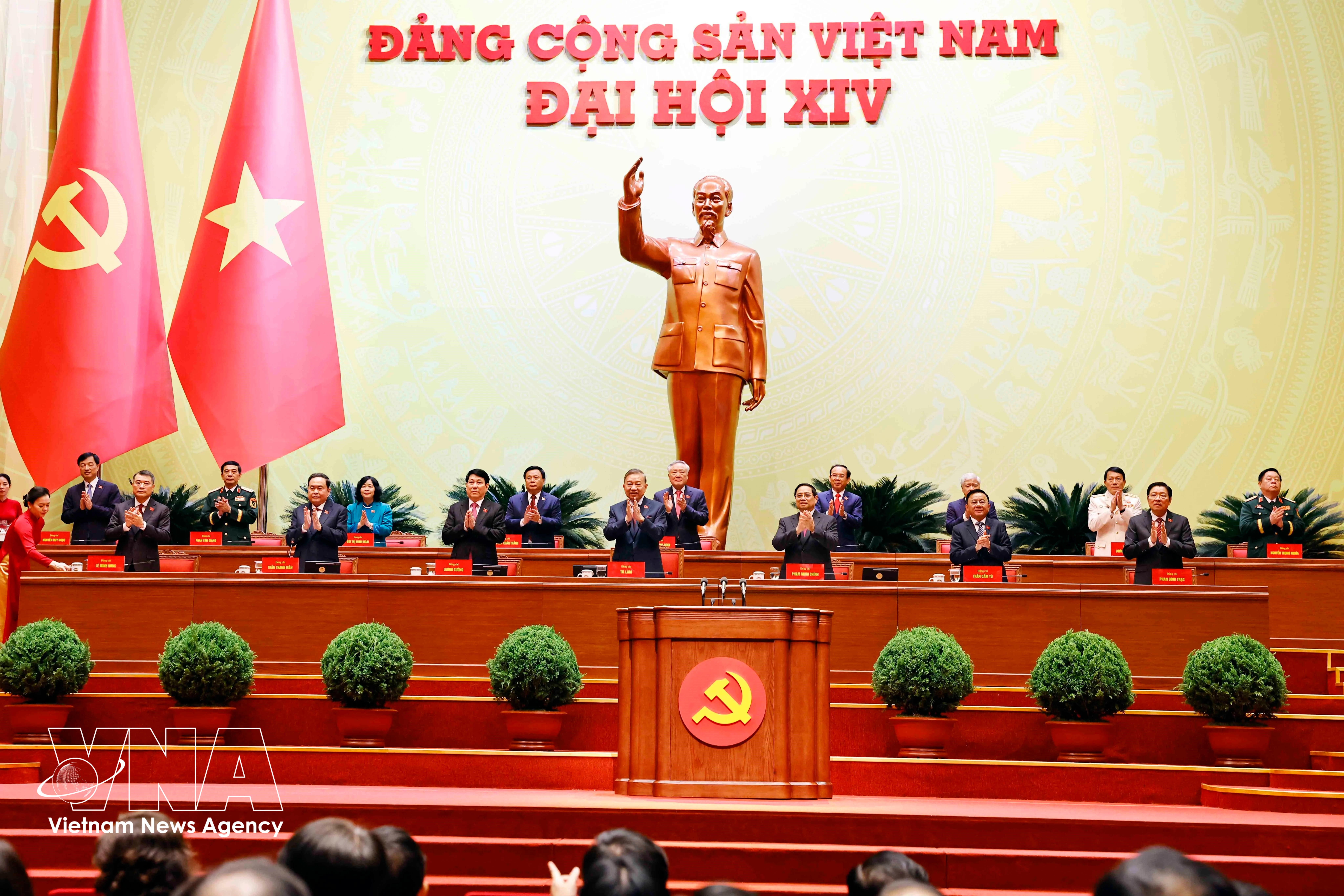
Hanoi (VNA) – In an era when information can shape public perceptions within minutes, Vietnam is renewing its political and ideological work, placing public trust at the centre of efforts to strengthen solidarity, build social consensus and mobilise resources for the country’s development.
Amid Vietnam’s drive to achieve double-digit growth and realise its two centenary goals, the political and ideological work is being renewed to keep pace with the rapidly changing digital information environment to sustain unity within the Party, build up social consensus and inspire development aspirations.
The first six months of 2026 saw a series of key tasks being carried out simultaneously, including translating the Resolution of the 14th National Party Congress into reality, successfully organising the election of deputies to the 16th National Assembly and People’s Councils at all levels, operating the two-tier local administration model, restructuring the organisational apparatus and implementing the strategic resolutions.
The workload is enormous while the information environment is becoming increasingly complex with the impact of “cognitive warfare” in cyberspace. This creates an urgent requirement to consolidate awareness within the Party, promote social consensus and maintain the people’s trust. All tasks of ideological and mass mobilisation work ultimately serve the supreme goal of maintaining and strengthening the people’s trust in the Party, the State and the political regime. That trust is the root of the "people-based posture" and an irreplaceable internal resource.
Whereas ideological challenges previously came mainly from distortions spread through traditional channels, AI and cyberspace have now fundamentally changed how information is disseminated. Accurate and inaccurate information, as well as truth and falsehood, are becoming increasingly intertwined. Fake news can spread within minutes while verification and correction usually take much longer. Therefore, the struggle on the ideological front is no longer waged in campaigns or around individual cases, but is a constant and continuous effort, unfolding hour by hour and minute by minute.
In this context, the Politburo issued Regulation No. 19-QD/TW on the political and ideological work within the Party, which carries particular importance. For the first time, a field long considered difficult to quantify has been placed within a framework with objectives, evaluation criteria and specific responsibilities assigned to each Party committee and each leader. More importantly, the ideological work must produce concrete results and products, and be measured by actual effects.
Practice shows that wherever the political and ideological work is carried out proactively, major Party policies enjoy a high level of consensus. The successful election of deputies to the 16th National Assembly and People’s Councils at all levels, with 99.68% of voters casting their ballots, reflected the people’s trust and sense of responsibility towards the country’s major decisions.
The organisation of national conferences to study and thoroughly grasp important resolutions of the Party was not merely a matter of communication, but also created a widespread political activity, helping quickly translate the resolutions into action. The Party Central Committee's Commission for Information, Education and Mass Mobilisation has completed 13 of 26 projects while giving advice to the Politburo and the Secretariat of the Party Central Committee on eight important issues, including Regulation No. 19-QD/TW.
These results not only reflect an enormous workload done, but also show that the political and ideological work is undergoing a strong shift from handling individual incidents to providing strategic advice closely linked to the country’s development requirements.
Reality also shows that delays in providing information and the avoidance of addressing issues of public concern can create an information vacuum, allowing fake news and misinformation to gain ground. The task, therefore, is not only to disseminate information more quickly, but also to improve the accuracy of forecasts; not merely to refute false information, but also to proactively provide accurate and timely information and establish a flow of reliable information capable of guiding public opinion.
Digital transformation is becoming one of the breakthroughs in the information, education and mass mobilisation sector. The formation of a digital ecosystem, initial application of artificial intelligence and development of a digital map identifying ideological “blind spots” have helped improve the capacity for forecasting, early warning and rapid response to emerging issues. So far, 97.62% of Party members regularly use the electronic Party member handbook while 100% of Party organisations register activities, submit reports and evaluate the quality of their activities via the electronic system.
However, technology is only a tool. People still remain the most important factor. No digital platform can replace officials’ closeness to the people, understanding of the people, and responsibility to lead by an example. To maintain public trust, officials must first speak truthfully, act properly and deliver effective results so that the people can see, trust, follow and join hands with them. When policies are translated into concrete results, false information will find it difficult to survive.
Trinh Van Quyet, Politburo member, Secretary of the Party Central Committee and Chairman of its Commission for Information, Education and Mass Mobilisation, has affirmed that “trust is the final line of defence, a ‘forbidden zone’ that no force is allowed to violate.”
This calls for a renewal of leadership methodology in the digital age. Instead of merely handling information after an incident already occurred, it is necessary to proactively gauge public sentiment, anticipate trends in public opinion and address at an early stage issues that could undermine public trust. In other words, the focus must shift from “managing information” to proactively “governing public trust”.
More broadly, the requirement to renew the political and ideological work today stems not only from changes in the information environment but also from the country’s own development aspirations. Vietnam has set two major goals – becoming a developing country with modern industry and upper-middle income by 2030, and a developed, high-income country by 2045. Realising these ambitions will require substantial resources, including the crucial resource of unity in will, social consensus and the people’s trust.
From now until the end of the year, the entire political system must make every effort to achieve growth of around 11.9% to fulfil the whole year's development targets. Every major policy must be popularised and explained clearly at an early stage; every new policy must be implemented in a well-organised and effective manner; and people’s concerns must be listened and addressed at the grassroots level from the outset. When words are matched by actions across the political system, social consensus will be formed.
President Ho Chi Minh once taught “'what benefits the people must be done to the utmost, and what harms them must be avoided at all costs.” Today, that teaching remains the core of the political and ideological work. When every policy is aimed at serving the people’s interests, and is understood, trusted and embraced by the people, it becomes the greatest strength enabling the country to overcome all difficulties and realise its development aspirations.
Where the people’s trust is secured, everything is secured!./.