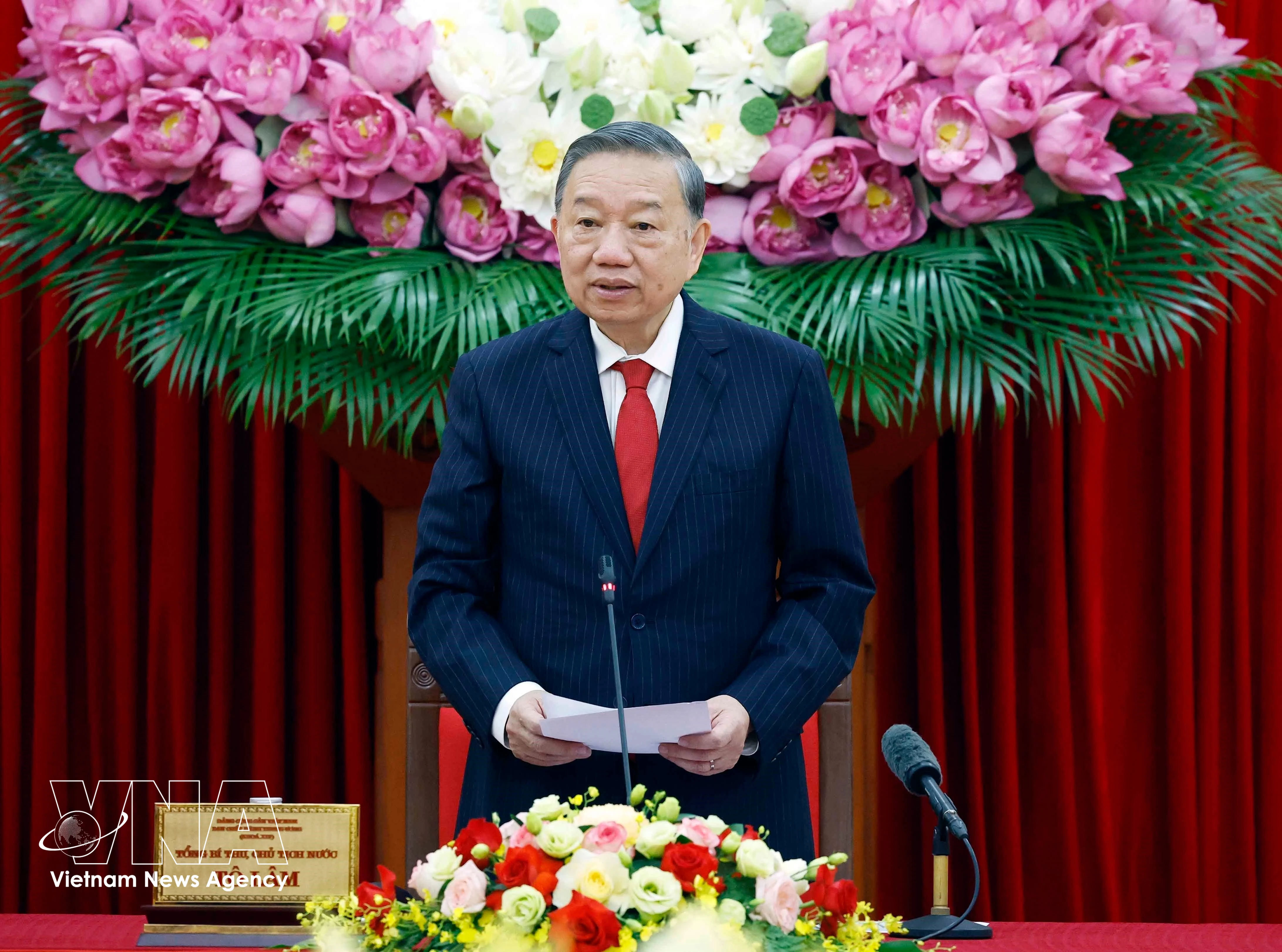
Hanoi (VNA) - The theoretical work for the 2026-2031 period must be more proactive and incisive, moving beyond explaining events after the fact to anticipating emerging challenges, addressing key bottlenecks and new contradictions in development, and delivering timely, effective input for Party policymaking, said Party General Secretary and State President To Lam.
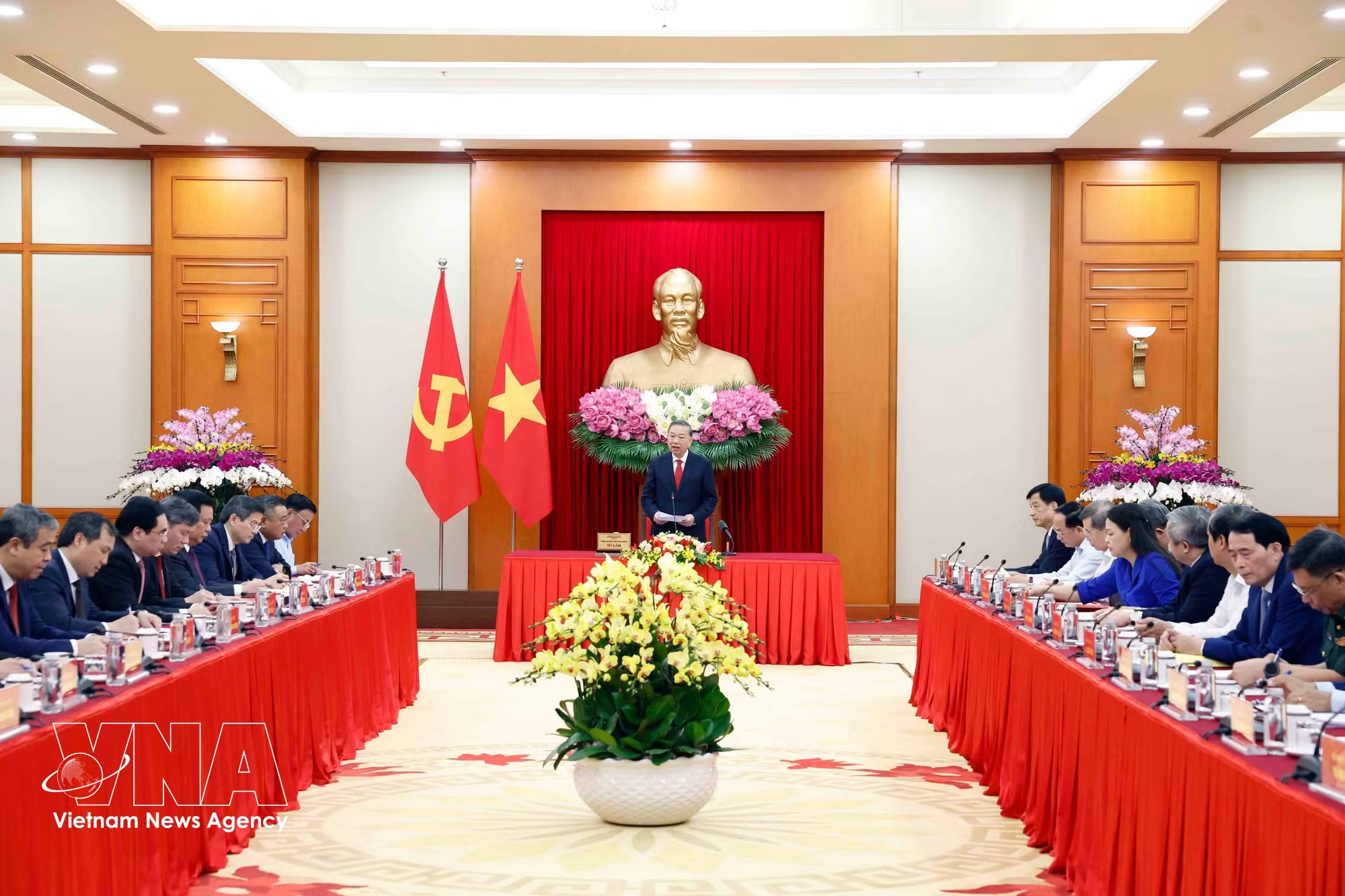
Chairing a working session with the Central Theory Council for the 2026-2031 term in Hanoi on June 9, General Secretary and President Lam praised the council’s contributions during the 2021–2026 term, especially its review of 40 years of Doi Moi (renewal), its drafting of documents for the 14th National Party Congress, and policy advice to the Politburo and Secretariat. Since the new term began, the council has already revamped its working methods and closely followed political tasks.
The council was urged to work closely with relevant agencies to review 100 years of the Party’s leadership over the Vietnamese revolution and 40 years of following the Party Platform, describing the effort as a major political and theoretical task. It should also promptly finalise detailed plans, methodologies, surveys and workshops, while linking central-level reviews with assessments at local and sectoral levels.
To support the delivery of the 14th National Party Congress's resolution, the top leader called for deeper research into socialism and Vietnam’s path toward socialism under changing global conditions, including socialist-oriented local governance, the transition period and emerging real-world developments.
He raised a number of strategic questions for further study, including how Vietnam can fully harness the power of market economy and unlock private sector resources while maintaining its socialist orientation and preventing extreme income inequality. He also demanded research on how to build a “constructive” institutional framework for digital space, safeguard “data sovereignty”, and transform Vietnam into a tech-savvy, prosperous and equitable nation. Further examination of new dimensions of the socialist rule-of-law state, socialist democracy and the building of socialist-oriented Vietnamese citizens is also needed, he said.
The council must zero in on major, urgent theoretical and policy issues facing the country, including Vietnam’s development model in a new era, an institutional framework for rapid and sustainable growth, modern national governance, strategic autonomy alongside global integration, and the impacts of digital transformation, green transition, energy transition, structural transformation, workforce and governance, he said, adding that also on the table is national comprehensive strength and Vietnam’s soft power, new forms of competition and conflict, and international development experience.
The leader pushed for refining the Party’s theoretical concepts and terminology to keep pace with new models and real-world developments. Vague or inconsistent definitions, he warned, could weaken the effectiveness and persuasiveness of Party policies.
He urged further study of governing ethics and culture, and power control given the Party’s role as the ruling force. The council should clarify new standards of responsibility, including setting an example, integrity, service, discipline, accountability, and the relationship between power and responsibility, as well as between leadership and service to the people to help build a truly clean and strong Party capable of leading the nation in a new era.
To that end, he stressed the need for widespread use of digital technologies, artificial intelligence and big data to sharpen analytical, forecasting and advisory capabilities.
He endorsed a plan to establish a political theory research network and hold a national conference on theoretical research, insisting both be practical, effective and policy-oriented rather than formalistic.
Innovation in theoretical research and the review of practical experience were also urged, including long-term monitoring of selected localities, sectors and pilot models as “living labs” to identify new trends, challenges and lessons. “Theory must be nourished by vibrant practice, tested in practice and return to guide development in practice,” he said.
He underscored the importance of developing a new generation of theoretical researchers, particularly young scholars, and fostering a democratic academic environment that encourages scientific debate while remaining committed to national interests and the Party’s ideological foundations and targets.
Ministries, agencies and local authorities were asked to support the council’s activities. Reviewing practical experience and cooperating on theoretical research is a political responsibility shared across the entire political system, he said.
The leader voiced confidence that the council will build on its 30-year tradition, raise the quality of its research and policy recommendations, and bolster its reputation through rigorous theoretical work, timely advice and meaningful contributions to the Party and State’s policymaking./.