Kuala Lumpur (VNA) - Throughout the Doi moi (renewal) and integration process, Vietnam’s independent and flexible foreign policy has helped the country safeguard its sovereignty, expand international relations and gradually assert an increasingly clear role on the regional and global arenas.
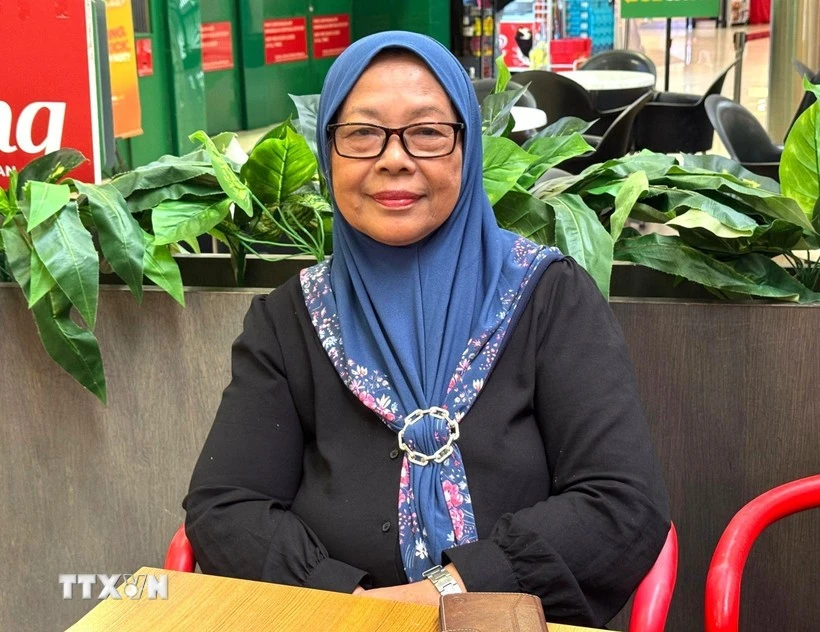
The assessment was made by Prof. Ruhanas Harun of the National Defence University of Malaysia in an interview with Vietnam News Agency correspondents in Kuala Lumpur on the occasion of the 14th National Congress of the Communist Party of Vietnam.
According to the expert, Vietnam’s diplomatic approach demonstrates mettle, resolve, independence and a strong capacity to adapt flexibly to the complex and fast-changing regional and global geopolitical environments. From a country bearing the heavy legacy of war, Vietnam has steadily risen to become a responsible member of the international community.
A prominent example is Vietnam’s active role within the Association of Southeast Asian Nations (ASEAN). Since joining the bloc in 1995, Vietnam has made significant contributions to strengthening ASEAN as a cohesive, stable and highly adaptive regional organisation. In return, ASEAN has provided a favourable framework for Vietnam to deepen integration, enhance security cooperation, expand economic development opportunities and strengthen socio-cultural links.
Amid rapidly evolving regional geopolitical and geostrategic dynamics, Ruhanas noted that foreign policy continues to play a pivotal role in safeguarding and advancing Vietnam’s national interests. Maintaining an independent and flexible stance, while remaining firm in the face of external pressures, has enabled Vietnam to preserve strategic balance. In this regard, ASEAN membership is of particular importance, creating a “safe space” that allows Vietnam to adapt and develop.
Referring to Vietnam’s goal of becoming a high-income developed country by 2045, the expert described it as a historic milestone marking the centenary of the nation’s founding. To achieve this ambition, Vietnam must continue to refine its institutions, develop an appropriate legal framework and encourage private-sector growth, while ensuring a balance between economic expansion and social equity, without sacrificing stability or public welfare. Given current growth momentum and ongoing efforts, she expressed confidence that Vietnam is fully capable of realising this goal.
Ruhanas also emphasised the close, two-way linkage of interests between Vietnam and Southeast Asia. A peaceful and stable Southeast Asia is a crucial condition for Vietnam to effectively pursue its development objectives, while a secure Vietnam with a robust economy and stable society will, in turn, serve as a driving force for peace, stability and shared prosperity across the region, she added./.