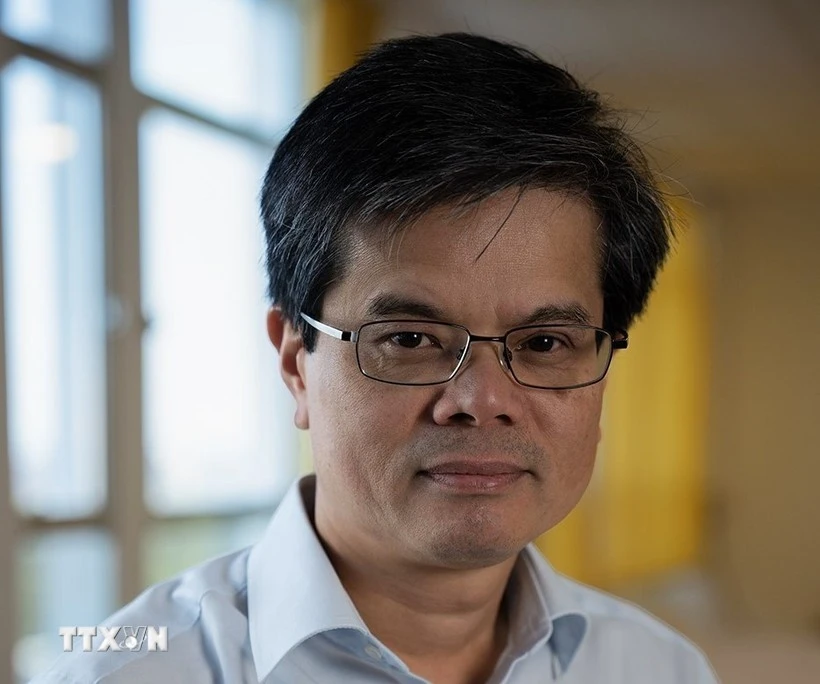
Paris (VNA) - The economic orientations outlined at the 14th National Congress of the Communist Party of Vietnam mark a “major strategic shift” towards building a foundation for sustainable, high-quality growth of the country in the coming period, according to Professor Nguyen Van Phu, Research Director at France’s National Centre for Scientific Research (CNRS).
According to Prof. Phu, the core of this shift lies in renewing the growth model—moving away from dependence on low-cost labour, resource exploitation and volume-driven foreign direct investment (FDI), towards development powered by knowledge, high technology, innovation and labour productivity. The private sector is identified as the central growth engine, alongside strong investment in education, science and technology, digital transformation and a national innovation ecosystem.
He stressed that this transformation is crucial to helping Vietnam avoid the middle-income or middle-growth trap, where growth stagnates at 6–7% without qualitative breakthroughs. Without decisive productivity gains, he warned, Vietnam would struggle to consolidate long-term development foundations despite recent achievements.
While Vietnam has sustained growth of 7 - 8% and recorded disbursed FDI of 27.62 billion USD in 2025 - the highest in five years - the economy remains heavily reliant on the FDI sector, which accounts for about 70% of exports. Domestic enterprises continue to face constraints in capital, technology and governance, while regional competitors such as India, Indonesia, Thailand and Malaysia are aggressively attracting high-quality FDI into strategic sectors including semiconductors, electric vehicles, data centres and the green economy.
In this context, Prof. Phu said the 14th National Party Congress should pursue a selective, upgrading development strategy. Key priorities are drawing in FDI with solid technology transfer and ties to the “Make in Vietnam” vision, speeding up institutional reforms to cut red tape, boost transparency, and make policies more predictable, and building up top domestic companies ready to compete regionally and globally. Focus should go to strategic sectors like semiconductors, AI, biotechnology, healthcare, the digital and green economies, and high-quality agriculture.
He also highlighted the importance of attracting non-FDI financial capital through the establishment of International Financial Centre (IFC) in Ho Chi Minh City and Da Nang, under the “one centre, two destinations” model. Ho Chi Minh City will focus on banking, capital markets and financial transactions, while Da Nang will target fintech, start-ups, technology funds and green finance. The centre is expected to attract 10–15 billion USD annually by 2030, though Vietnam will face stiff competition from established hubs such as Singapore and Hong Kong (China).
Overall, Prof. Phu assessed the Congress’s orientations as correct and timely, but stressed that success hinges on swift, consistent and substantive implementation. Vietnam is no longer a low-cost option and must now compete on institutional quality, innovation and policy credibility. The year 2026 will be pivotal in determining whether the country can strengthen its role as a regional production and financial hub or risk prolonged stagnation.
On institutional reform, he welcomed the designation of the private sector as the “most important driving force” of the economy, stressing that genuine business confidence depends on substantive administrative reform, transparent procedures and fair access to land, credit and resources. Strengthening protection of property and intellectual property rights, improving access to finance and promoting innovation, especially for small and medium-sized enterprises, are also essential.
Prof. Phu underscored the need to mobilise overseas Vietnamese resources. Beyond remittances estimated at 16 billion USD in 2025, overseas Vietnamese contribute valuable expertise, management experience and global networks. He called for a shift from “mobilisation” to “substantive engagement”, underpinned by transparent institutions, non-discriminatory investment rights and targeted incentives for high-tech and green projects.
If supported by rigorous implementation and independent oversight, he concluded, these orientations could help Vietnam overcome the middle-income trap, strengthen its position in global value chains and enhance its role as a bridge linking Vietnam with Europe in economy and knowledge by 2030./.