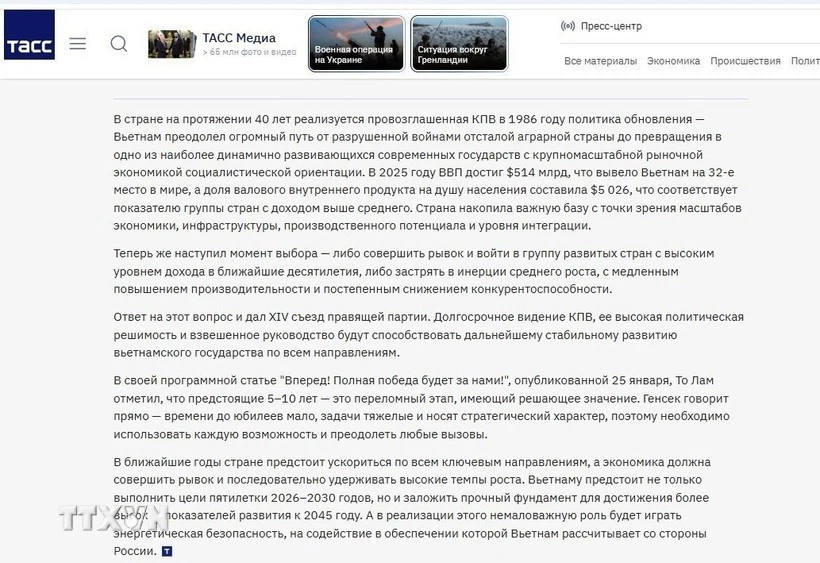
Moscow (VNA) – Russia’s TASS news agency on January 28 published an article by Yuri Denisovich, TASS bureau chief in Vietnam, offering positive assessments of the outcomes of the 14th National Congress of the Communist Party of Vietnam (CPV) and their significance for bilateral relations.
In his article, the author observed that Vietnam’s development objectives, as set out by the Congress, are not limited to the next five-year period but also outlined long-term orientations for building Vietnamese society through 2045. He noted that Russian President Vladimir Putin sent a congratulatory message and held a phone call to congratulate To Lam on being elected General Secretary of the CPV Central Committee for the 14th term.
According to the author, Russia viewed the continued leadership of General Secretary Lam positively, considering it an important factor in further deepening cooperation with a key and reliable partner in Southeast Asia and in advancing shared interests on the international stage.
The article highlighted that cooperation between the two countries has traditionally focused on strengthening security and stability in the Asia–Pacific region. At the same time, it contributes to the consistency and predictability of Vietnam’s overall foreign policy, thereby creating favourable conditions for continued comprehensive cooperation, particularly in areas such as economy and energy.
The author underscored that the CPV remains the country’s leading political and socio-political force. The number of Party members has now exceeded 5.6 million, an increase of around 500,000 compared to the time of the 13th National Congress in 2021. This growth was cited as evidence of rising public support for the Party’s policies.
Reflecting on Vietnam’s development path, the article noted that over the past four decades since the Doi moi (Renewal) process initiated by the CPV in 1986, Vietnam has transformed from a war-ravaged, underdeveloped agricultural nation into one of the most dynamically developing countries with a large-scale, socialist-oriented market economy. In 2025, its gross domestic product was reported at 514 billion USD, ranking 32nd globally, while GDP per capita surpassed 5,000 USD, placing the country among upper-middle-income economies. The author pointed to the solid foundations Vietnam has built in terms of economic scale, infrastructure, production capacity and international integration.
At the same time, the article observed that the country now faces a strategic choice: either to achieve a breakthrough and join the ranks of high-income developed countries in the coming decades, or to risk being trapped in middle-income stagnation marked by slow productivity growth and declining competitiveness. In this regard, the 14th National Congress was seen as providing a clear answer. The long-term vision, strong political resolve and balanced leadership of the Communist Party of Vietnam were assessed as key factors underpinning the country’s stable and sustainable development across all fields.
The TASS bureau chief in Vietnam concluded that the nation needs to accelerate progress in all priority areas, achieve a decisive economic leap and maintain high, stable growth. Beyond meeting the targets of the 2026–2030 five-year plan, it will also need to lay firm foundations for attaining even more ambitious development goals by 2045./.