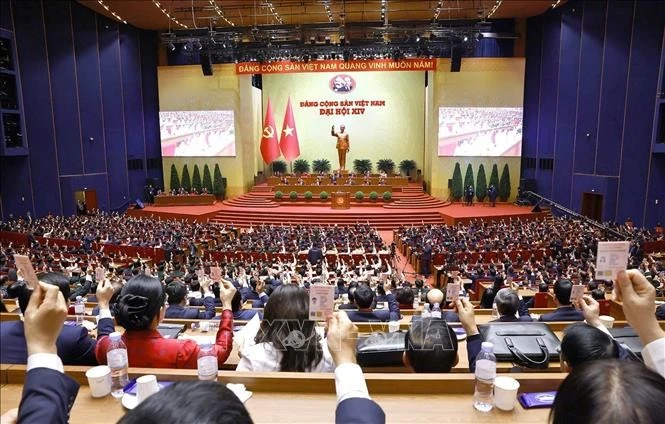
Hanoi (VNA) – Placing the people at the centre of development is reflected not only in participatory governance mechanisms but also in Vietnam’s broader development strategy, according to Kyril Whittaker, a UK-based Vietnam specialist.
Sharing his views with Vietnam News Agency correspondents in London, Whittaker noted that Vietnam’s 40-year Renewal (Doi Moi) process has succeeded thanks to three closely intertwined factors - a scientific and practical approach to reform, the Communist Party of Vietnam’s leadership role, and the principle of placing the people at the heart of all policies.
According to Whittaker, Vietnam’s reform pathway is grounded in national knowledge while selectively absorbing international experience and drawing directly on the lived realities of working people. Vietnam’s governance model allows input from across society, ranging from local authorities, experts, trade unions and mass organisations to citizens outside formal institutional frameworks. This was clearly demonstrated at the 14th National Party Congress, which received more than 14 million public contributions to draft documents nationwide, ensuring that policies are shaped not only by theory but also by practice and expertise through a multi-dimensional approach.
The Party’s leadership, Whittaker stressed, provides the theoretical foundation for reform, ensuring that socialist construction is guided by both theory and reality, and that legislation and governance reflect Vietnam’s historical and practical conditions. Socialism in Vietnam, he said, is not dogmatically copied from any external model but continuously adapted to national characteristics, with the consistent goal of improving people’s living standards and strengthening collective mastery.
Recent administrative reforms and the application of digital technology have illustrated this approach. Initiatives such as the VNeID platform have reduced bureaucratic barriers, streamlined procedures, and expanded public participation in policymaking, including contributions to the 14th Congress. At the same time, the Party remains committed to revolutionary ethics, integrity and thrift, while resolutely combating corruption, waste and individualism—efforts that have drawn positive international attention, including in the UK.
Placing the people at the centre of development is the root of all policies of Vietnam, he noted, highlighting that policies identifying people as both the centre and driving force of development ensure that improvements in living standards and collective mastery remain the primary measures of national progress.
Unlike growth models driven solely by profit, Vietnam’s approach seeks to align economic development with human well-being. Whittaker pointed out that during the COVID-19 pandemic, this people-centred approach helped protect lives while maintaining economic growth, in contrast to many economies that experienced severe contraction and social hardship. Major infrastructure projects, from the Can Tho - Ca Mau expressway and urban metro systems in Hanoi and Ho Chi Minh City to future initiatives in nuclear energy and high-speed rail, consistently prioritise poverty reduction and improved livelihoods.
From Whittaker’s perspective, Vietnam’s Doi moi (Renewal) process represents a strategic development choice rather than a purely economic reform agenda. By firmly establishing the people as the subject of all policymaking, the principle of “people as the root” has created lasting resilience for Vietnam’s development model, enabling the country to maintain political stability while continuously renewing itself in response to the challenges of the times./.