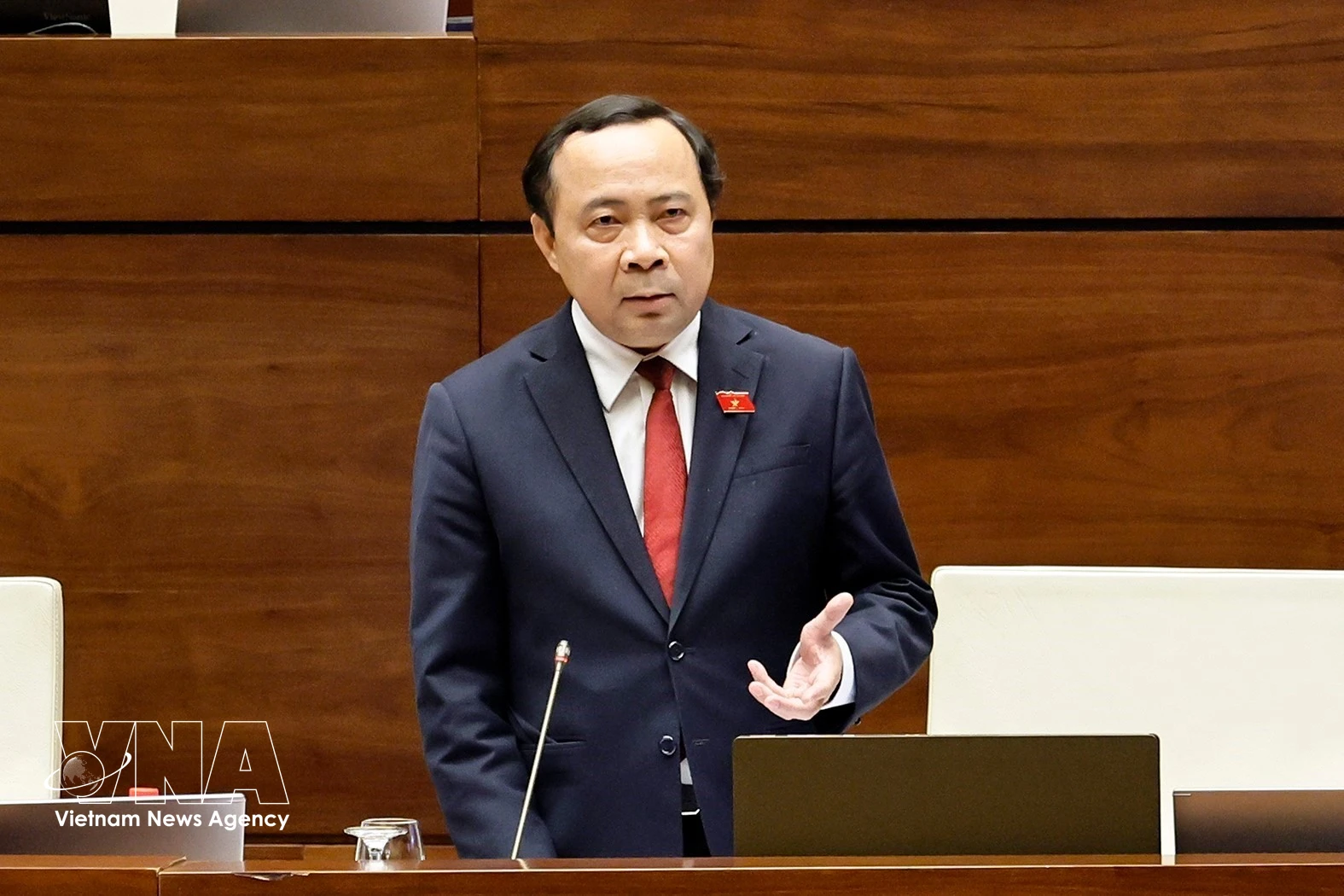
Hanoi (VNA) – Slow disbursement of funding for science, technology, innovation and digital transformation, the limited commercialisation of research outcomes, and inadequate data sharing were among the issues raised by National Assembly deputies in their questioning of Minister of Science and Technology Vu Hai Quan at the 16th legislature's second session in Hanoi on November 12.
Disbursement still faces bottlenecks
Deputy Hoang Minh Hieu from Nghe An province said the 2026 state budget allocated about 95 trillion VND (3.65 billion USD) for these fields. As of October 30, disbursement was only 42.12%, with innovation at 27.98%, and digital transformation 29.90%. More than 18 trillion VND was not allocated in detail, and more than VND 8 trillion was proposed for return or cancellation.
He asked for the causes, the responsible unit, and the basis for raising the budget to about 120 trillion VND in 2027 when absorptive capacity remains limited.
Deputy Nguyen Thi Thu Dung from Hanoi said central-level disbursement was 46.18% and local-level disbursement 38.5%, while innovation and digital transformation were both below 30%. She asked whether the bottlenecks are in mechanisms and policies or in rollout, and demanded specific solutions and commitments for 2027.
Quan cited four main causes. The budget scale jumped in a short time: annual recurrent sci-tech spending was about 12 trillion VND, but the scope now includes recurrent and investment spending for science, technology, innovation and digital transformation, several times larger.
After the Politburo's Resolution 57-NQ/TW was issued in late 2024, building and completing legal regulations to concretise it took time. Many new rules took effect in late 2025 or in 2026, affecting task performance and disbursement.
Research tasks are now tied more closely to practical problems, enterprise orders and the involvement of institutes and universities. That requires more complex preparation, task identification and rollout.
In some agencies, units, and localities, enforcement has been weak, and there is hesitation in following new mechanisms and policies, Quan said.
The ministry also will not disburse at all costs because of schedule pressure, he stated, stressing that resource allocation must be tied to efficiency.
Commercialisation gap
Quan said many research results are not yet eligible for production, intellectual property (IP) valuation is difficult, investment capital is lacking, support policies are not synchronous, especially infrastructure and testing labs; and commercialisation capacity and State-university-enterprise cooperation remain limited.
On solutions, he said the ministry will improve the quality of technology supply, address difficulties in IP valuation, and strengthen enforcement capacity. It has directed some unit leaders to work directly with institutes and schools to support trial valuation of specific products and build guidance.
On technology supply-demand matching, he said that since early 2026, the Techmart exchange has uploaded about 80,000 ideas and products; only 8,000 transactions succeeded, with total capital of about 13 billion VND. The law allows enterprises to deduct up to 20% for a science, technology and innovation development fund. But among more than 300 enterprises with such funds, most are State-owned, and their capital funds account for more than 85%.
The ministry is piloting support for small and medium-sized enterprises applying AI to raise productivity. When an enterprise needs AI but lacks personnel, the ministry connects it with organisations and universities with experts and scientists and supports up to 3 billion VND to deploy the solution.
In each locality, he said he wants to find 3-5 potential enterprises to bring science, technology and innovation into application./.