
Hanoi (VNA) – Minister of Finance Ngo Van Tuan clarified measures to improve capital efficiency and secure resources for achieving the double-digit growth target for 2026 while addressing the second session of the 16th National Assembly on October 31.
Replying to lawmakers' questions about how to obtain annual growth of more than 10% during 2026–2030, particularly given the economy’s heavy reliance on credit, Tuan said that target requires total investment across society to reach around 40% of GDP, while the incremental capital-output ratio (ICOR) must be brought down to 4.5–4.8.
Capital mobilisation needs during 2026–2030 are expected to be 2.21 times those of the 2021–2025 period.
With regard to the excessive dependence on the credit market, he said the Government has gradually introduced measures to broaden access to capital through its stock market development strategy, with initial results already achieved.
The minister cited data as showing that capital raised on the market in the first nine months of 2026 increased 15% year on year. Notably, public share offerings rose 60% while private share placements climbed 80%. Since late 2025, 10 companies have conducted initial public offerings (IPOs), raising more than 60 trillion VND (2.32 billion USD), nine times the total amount mobilised throughout the 2021–2025 period.
The stock market development strategy sets a target of bringing total stock market capitalisation to 120% of GDP by 2030. Currently, the market capitalisation of listed shares is equivalent to around 90% of GDP, while the bond market accounts for approximately 50% and the derivatives market for around 20–30%.
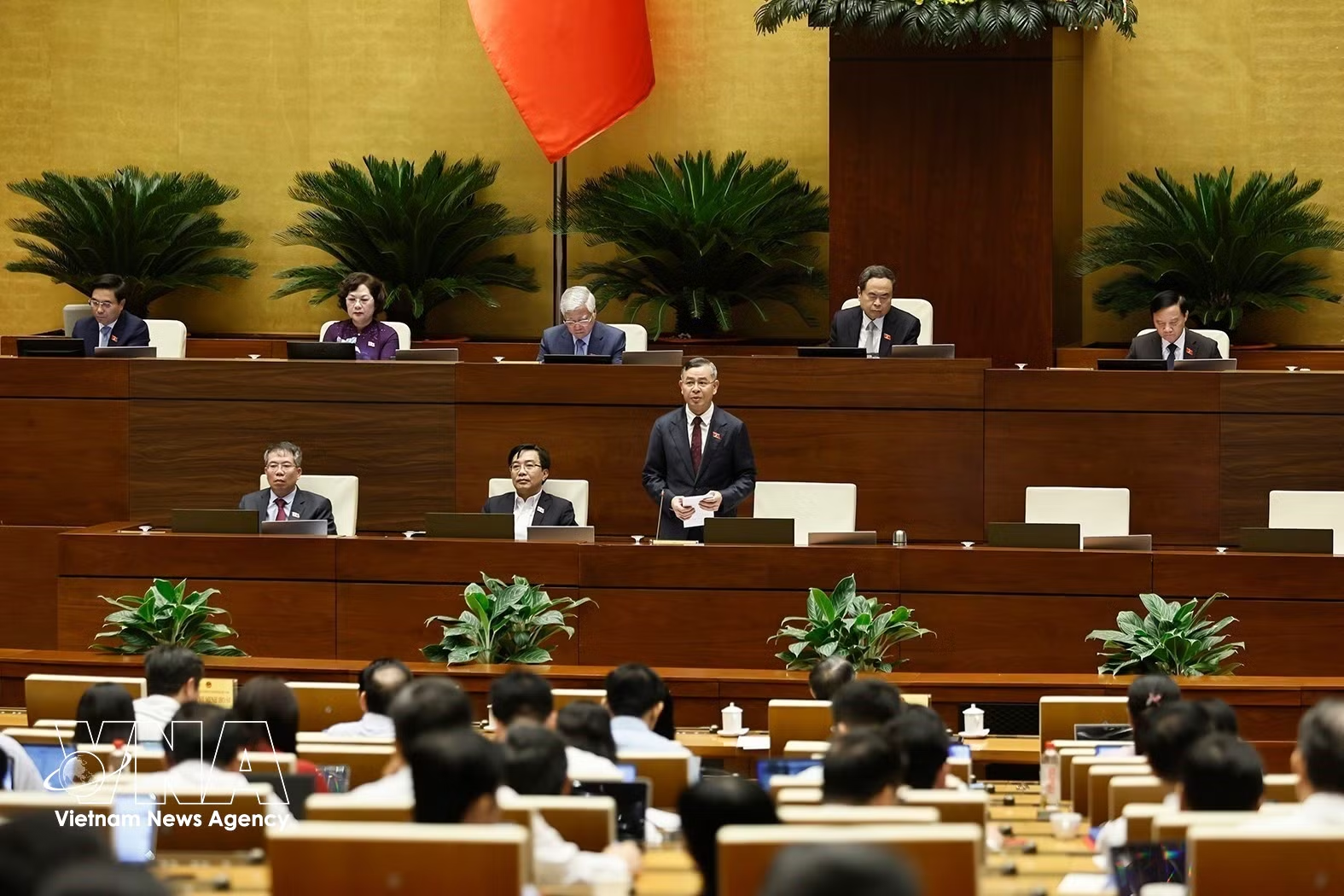
To achieve these targets, he said the legal framework must be further strengthened and transparency ensured to make the market more attractive to investors. Other priorities include accelerating the equitisation of State-owned enterprises, preventing excessive concentration, attracting more foreign investors and developing professional investment institutions.
Regarding inflation control, the minister said keeping inflation at 4.52% during the first nine months represents a major effort amid continued global economic volatility and mounting price and supply pressures. Alongside flexible and prudent monetary policy to stabilise exchange rates and interest rates, large-scale fiscal measures have been rolled out to support people and businesses.
Over state budget management, deputies raised concerns about the quality of budget estimates, the carryover of funds and advance payments. Tuan acknowledged that estimates have not always accurately reflected actual implementation, adding the Ministry of Finance is working to address this shortcoming.
In 2025, actual state budget revenue was 36% higher than the estimate and 34% above the 2024 figure. One reason, he said, is the limited capacity for analysis and forecasting. Greater application of information technology is therefore needed to improve forecasts and ensure that budget estimates reflect actual conditions more accurately.
The official stressed that improving project preparation and implementation is crucial to accelerating progress and reducing the volume of carryover funds and outstanding advances.
Also on October 31, Governor of the State Bank of Vietnam (SBV) Pham Duc An clarified a number of issues pointed out by deputies.
He said that several banking indicators, including the credit-to-GDP ratio, the structure of short-term deposits and medium- and long-term lending, and liquidity, have been raised by economic experts and representatives of the World Bank (WB) and International Monetary Fund (IMF) during their meetings with the SBV.

(Photo: VNA)
An stressed that the central bank remains committed to maintaining macroeconomic stability, curbing inflation and managing exchange rates to contribute to economic growth. Balancing these objectives requires a flexible, practical approach rather than a fixed formula.
Regarding lending and credit, the governor said the SBV will continue to manage credit growth, which currently stands at around 12.27%. Interest rates will be managed in a way that controls the cost of capital and supports production and business activities.
Specifically, deposit interest rates have risen by 1.42%, while lending rates have increased by only 0.99%, indicating a narrowing gap between the two. For real estate credit, the central bank is maintaining close control, with growth currently at around 9.84%, below the overall credit growth rate of the economy.
On access to finance for small- and medium-sized enterprises (SMEs), An said the SBV has worked with the Vietnam Association of SMEs to seek ways to lower interest rates and facilitate access to capital, with a focus on cash-flow-based lending.
He affirmed that the SBV will continue encouraging credit institutions to expand lending to SMEs while improving the legal framework to give lenders greater confidence in extending credit./.