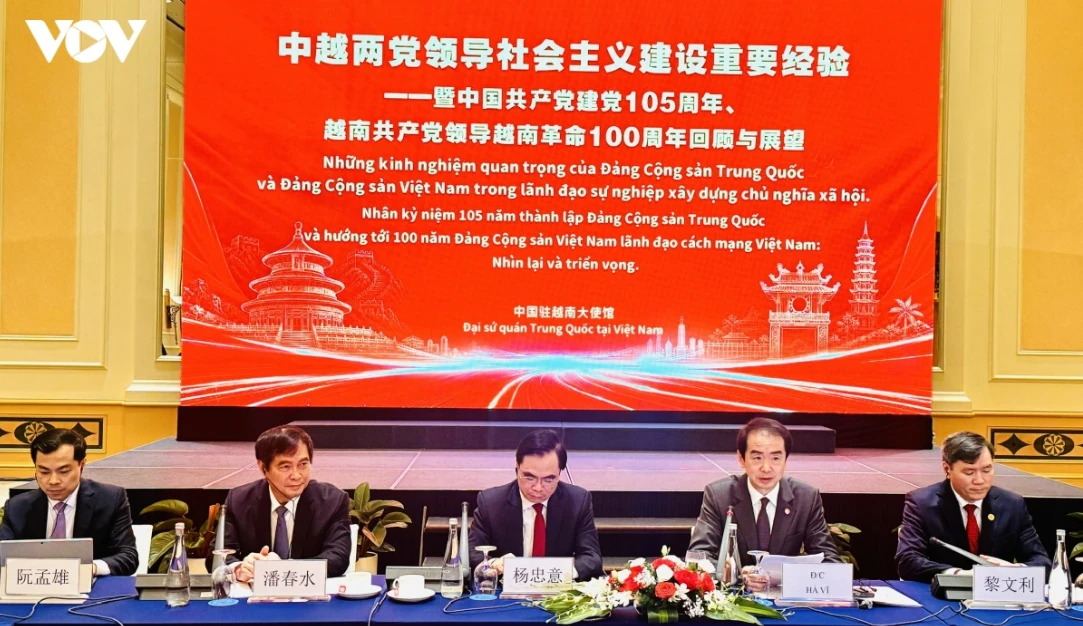
Hanoi (VNA) – The Chinese Embassy in Vietnam hosted a seminar in Hanoi on July 8 to share the key experiences of the Communist Party of China (CPC) and the Communist Party of Vietnam (CPV) in leading the cause of socialism building.
Opening the seminar, held on the occasion of the CPC's 105th founding anniversary, Chinese Ambassador He Wei highlighted the long-standing ties between the two parties and countries, nurtured by President Ho Chi Minh, Chairman Mao Zedong and generations of leaders of both sides. From their early struggles, the two communist parties have successfully charted their own paths to modernisation, demonstrating the enduring vitality of scientific socialism.
Throughout a century of development, the two sides have remained resilient in the face of changing global circumstances, continuously strengthening the Party building to reinforce their leadership and provide the political foundation for socialism building in each country, he added.
Under the CPC's leadership, China has transformed itself from a poor and underdeveloped country into the world's second-largest economy while Vietnam, led by the CPV, has maintained robust economic growth for more than two decades and emerged as one of the world's top 20 trading nations.
Assoc. Prof. Dr Duong Trung Y, member of the CPV Central Committee and Editor-in-Chief of the Communist Review, said experiences of the two parties carry profound theoretical and practical significance. Although each country has pursued its own development path and model, their achievements have been underpinned by a number of shared principles of universal value.
He noted that a people-centred approach is a defining feature in both countries. Ultimately, the success of socialism building should be measured by improvements in people's quality of life, well-being and all-round development.
Participants from the two sides reviewed the history, development and cooperation between the CPC and the CPV throughout the periods of revolutionary struggles, national construction and development.
During the struggle for national independence, the two parties supported each other and shared revolutionary experience. In the subsequent period of socialism building, they increased expertise exchanges on state governance, economic development and political system building. During China's reform and opening-up process and Vietnam's Doi moi (Renewal), the two parties have further shared experiences in development, economic and trade cooperation, and international integration.
Today, Party-to-Party cooperation has broadened to encompass science – technology, defence, culture, education and innovation, participants said.
They proposed that the two sides further deepen research and expertise sharing on the Party and socialism building under contemporary conditions. The experience accumulated through decades of revolutionary leadership and national development, they said, represents a valuable shared asset and provides a solid foundation for boosting theory exchanges and mutual learning to help enhance leadership and governance capacity in both countries.
With the traditional relationship of being both comrades and brothers, continued efforts to strengthen political trust, build on shared values and look towards the future will help advance relations between the two parties and countries in a more stable, substantive and sustainable manner while contributing to peace, stability and development in the region and the wider world./.