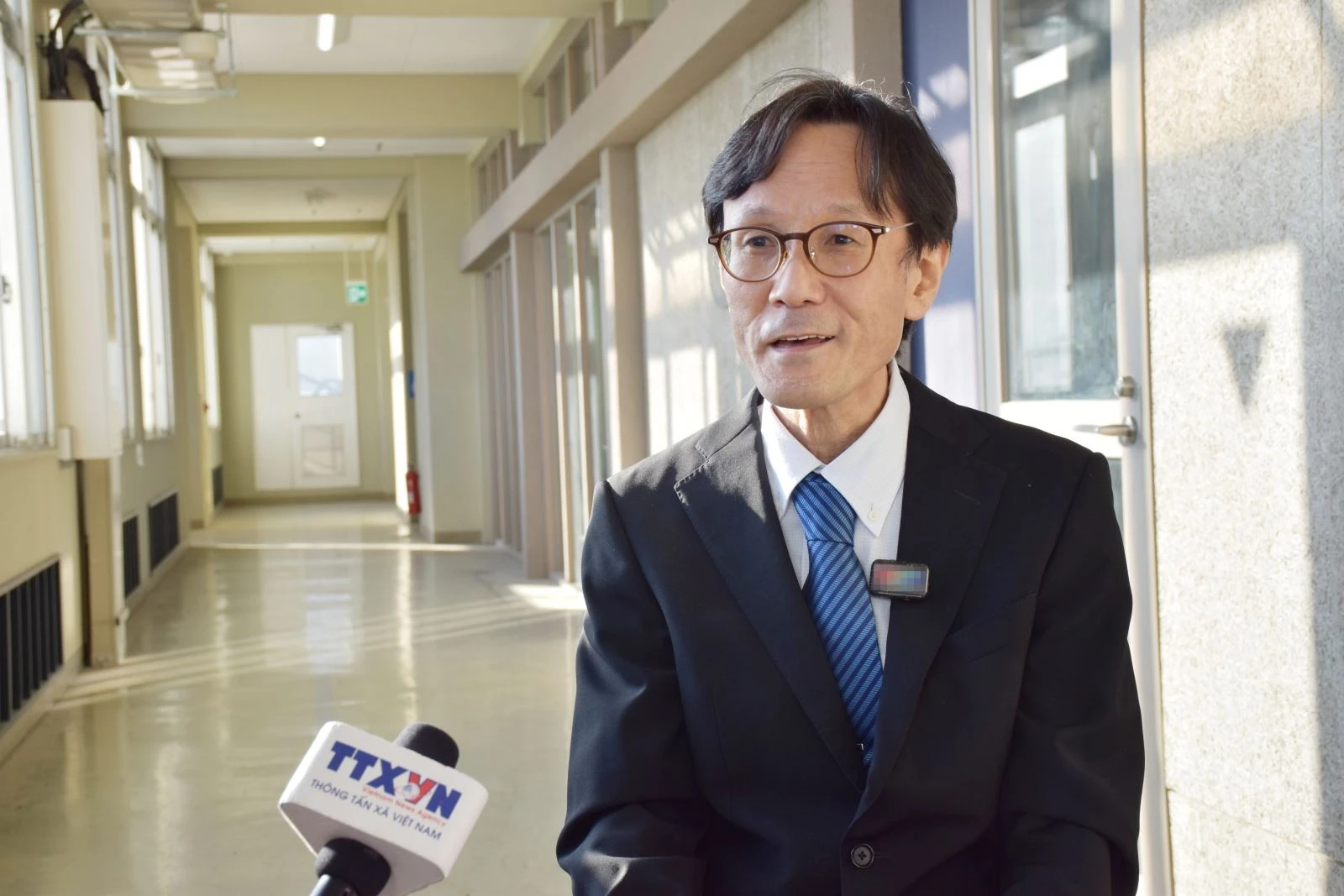
Tokyo (VNA) - Vietnam is moving beyond its traditional role as a “balancing” nation among major powers, evolving into a “co-creative partner” and a “connectivity hub” for the region, said Professor Shimizu Masaaki from Japan’s University of Osaka.
He shared this view with Vietnam News Agency correspondents in Tokyo ahead of the 14th National Congress of the Communist Party of Vietnam.
According to Professor Shimizu, while the 13th National Party Congress was “foundational” in nature, laying out a long-term vision toward 2045, the draft documents to be submitted to the 14th Congress demonstrate a stronger sense of urgency and a spirit of “breakthrough.”
The most notable new element, he observed, is the identification of Vietnam as entering a “new era” - that of the nation’s rise. Among orientations within socio-economic development, there is also a clear shift in growth thinking, from prioritising speed to emphasising quality. In this context, institutional reform aimed at removing bottlenecks is regarded as a critical breakthrough to unlock development resources.
Commenting on the draft documents’ stronger emphasis on innovation, the green economy, and digital transformation, the professor noted that this reflects Vietnam’s increasingly clear awareness of the risk of falling into the middle-income trap and its determination to transform its growth model.
In the new development model, Vietnam’s competitive advantage, he said, is no longer primarily based on low-cost labour or natural resources, but rather on “brainpower” and “data” as strategic resources. If implemented effectively, this approach will enable Vietnam to move deeper into global value chains instead of remaining at the semi-processing stage, Shimizu assessed, adding that a major challenge lies in the country’s capacity and pace in training high-quality human resources to meet new demands.
On foreign affairs, he noted that the continued adherence to “bamboo diplomacy” in the draft documents reflects Vietnam’s growing confidence. Maintaining independence and self-reliance amid complex geopolitical dynamics underscores the country’s aspiration to be a responsible member and a reliable bridge for peace and stability in Southeast Asia.
Regarding Vietnam–Japan relations, particularly as Vietnam accelerates deep international integration in line with the spirit of the draft documents of the 14th Congress, the expert noted that bilateral ties are entering a phase of “substantive and co-creative cooperation” based on the Comprehensive Strategic Partnership. Japan, he said, has strengths in core technologies and governance experience, while Vietnam possesses a dynamic market and a strong aspiration for transformation.
In areas such as digital transformation and green technology, Japan can support Vietnam in infrastructure development and standard-setting. Notably, cooperation in human resources development should be elevated toward training high-quality engineers and specialists, rather than focusing mainly on technical intern programmes as in the past. The two countries can jointly address shared challenges such as energy security and population ageing, thereby shaping a model partnership for the region, he suggested./.